
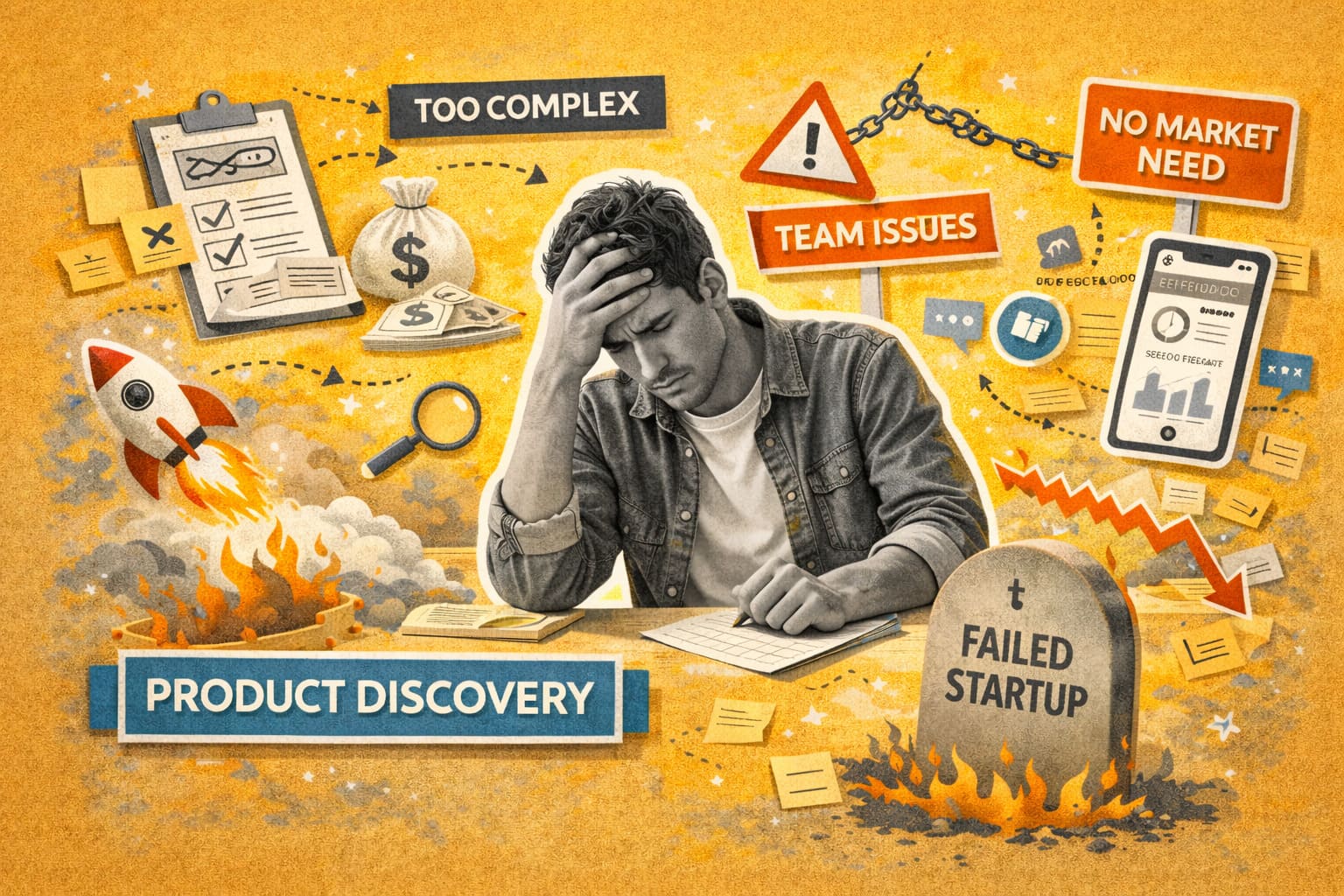
Building a Minimum Viable Product (MVP) is arguably the most critical milestone for any early-stage startup. It marks the transition from abstract idea to tangible reality. However, the path to market is littered with the remains of ambitious projects that failed not because the idea was bad, but because the execution of the MVP was flawed. In the fast-paced world of technology, speed is often prioritized over strategy, leading founders into traps that are difficult—and sometimes impossible—to escape.
At Rethink Lab, we’ve seen firsthand how a well-executed MVP development process can catapult a startup to success, while a series of avoidable blunders can drain capital and morale. This comprehensive guide explores the most common MVP mistakes that kill early-stage startups and provides actionable strategies to ensure your product survives the 'valley of death' and finds true product-market fit.
The Overbuilding Trap: Why More is Often Less
The most frequent mistake founders make is falling in love with their vision to the point where they refuse to launch anything less than a 'perfect' product. This leads to the 'Feature Creep' pandemic, where the MVP becomes a bloated, confusing version of what should have been a simple tool.
The Psychology of Overbuilding
Founders often feel vulnerable. They worry that if the product doesn't have every conceivable feature, users will think it's 'unfinished' or 'unprofessional.' This fear results in delayed launch dates. When you spent six months building features instead of three, you aren't just losing time; you are burning through your limited runway without receiving a single byte of user feedback.
The Cost of Complexity
Every additional feature adds complexity to the code, the user interface, and the maintenance schedule.
- Increased Bugs — More code means more potential points of failure.
- Diluted Value Proposition — If your app does ten things poorly, users won't notice the one thing it does exceptionally well.
- Support Burden — Even simple features require documentation and customer support.
Warning
If you are proud of every single feature in your MVP on launch day, you have probably launched too late. The goal is to solve one problem exceptionally well, not ten problems mediocrely.
To avoid this, we recommend a strict product discovery phase where you identify the 'Atomic Unit' of your product—the smallest possible action that provides value to the user.
Skipping Validation: Building in a Vacuum
Many startups fail because they build something nobody actually wants. This sounds obvious, yet it happens daily. Founders often rely on 'gut feeling' or internal feedback from friends and family rather than cold, hard market data.
The Echo Chamber Effect
When you spend all your time talking to your co-founders and investors, you create an echo chamber. Investors might like the 'concept,' but they aren't the ones who will use the product daily.
How to Properly Validate
Validation should happen before a single line of code is written.
- Problem Interviews — Talk to potential customers about their pain points. Don't mention your solution yet.
- Landing Page Tests — Create a 'smoke test' where users can sign up for a waitlist for a specific value proposition.
- Concierge MVPs — Perform the service manually before automating it with software.
By leveraging consulting & mentorship, founders can learn how to interpret market signals objectively rather than through the lens of confirmation bias.
Choosing the Wrong Tech Stack: The Foundation of Scale
Early-stage founders often find themselves at two extremes: using outdated tech because it's familiar, or chasing 'shiny object' technologies that are unproven or overly complex.
The 'Over-Engineered' Stack
Using a microservices architecture with Kubernetes for a product that has zero users is a recipe for disaster. It increases development time exponentially and makes pivoting difficult.
The 'Technical Debt' Stack
Conversely, using a 'no-code' tool that can't scale past 100 users might force you to complete a web-app development rewrite just as you start to gain traction, killing your momentum.
| Approach | Pros | Cons |
|---|---|---|
| No-Code | Extremely fast, low cost | Limited customization, scaling issues |
| Full-Stack JS (React/Node) | Great talent pool, versatile | Can be overkill for simple landing pages |
| Low-Code Hybrid | Balanced speed and scale | Requires specific expertise |
If you lack a technical lead, bringing on a technical co-founder or a fractional CTO can save you hundreds of thousands of dollars in future refactoring costs. They ensure your stack is 'boring' enough to be stable but modern enough to be scalable.
Poor UX/UI: The Silent Killer of Conversion
There is a misconception that 'Minimum Viable' means 'Ugly and Hard to Use.' While you don't need a world-class design for an MVP, a poor user experience (UX) can mask the true value of your product. If a user can't figure out how to navigate your app, they will churn, and you'll wrongly assume they didn't like the core idea.
Common UX Blunders in MVPs
- Hidden CTAs — Users shouldn't have to hunt for the 'Get Started' button.
- Information Overload — Too much text on the dashboard confuses the user journey.
- Lack of Feedback Loops — When a user clicks a button and nothing happens for 3 seconds, they think it's broken.
Pro Tip
Invest in a professional UX audit before your public launch. A fresh set of expert eyes can identify friction points that you have become blind to after months of development.
Investing in targeted UX/UI design ensures that the 'Viable' part of MVP is respected. Good design builds trust, and trust is the currency of the early-stage startup.
Scaling Before Substantiating: Premature Optimization
Premature scaling is often cited as the #1 reason startups fail. This isn't just about hiring too many people; it's also about technological scaling.
Engineering for Millions, Serving Hundreds
We often see founders obsessed with 'what happens when we have a million users.' They spend months building automated load balancers and complex data pipelines. These are 'high-class problems' that you should only solve once you actually have the users.
In the MVP stage, your code doesn't need to be infinitely scalable. It needs to be 'disposable' enough to allow for a pivot but 'robust' enough to provide a reliable service. This balance is what we call rapid development.
The Feedback Loop Failure: Ignoring the Data
An MVP is a learning tool. If you aren't collecting data, the MVP is useless. Many startups launch, see some traffic, and then wonder why they aren't growing. Without analytics, you're flying blind.
Essential Metrics for MVPs
- Activation Rate — Of those who sign up, how many actually perform the 'key action'?
- Retention Rate — Are users coming back after the first day? The first week?
- Customer Acquisition Cost (CAC) — Is it sustainable?
Setting up workflow automation to track these metrics automatically can free up your time to focus on product iterations.
Underestimating the Need for Marketing
'Build it and they will come' is a lie. Even the best MVP needs a distribution strategy. Startups often spend 100% of their budget on development and 0% on acquisition.
The Distribution Trap
Your MVP needs a 'wedge'—a specific community or channel where your target audience hangs out. Whether it's LinkedIn, specialized forums, or cold outreach, you need a plan to get the first 10, 100, and 1,000 users.
Danger
Do not confuse 'Marketing' with 'Buying Ads.' For an MVP, organic feedback from a niche community is 10x more valuable than thousands of clicks from disinterested strangers.
The Role of AI in Modern MVP Development
In 2024 and beyond, failing to leverage AI is a mistake in itself. AI automation and AI prototyping have drastically reduced the time it takes to build and test ideas.
How AI Changes the MVP Game
- Instant Mockups — Use AI to generate high-fidelity UI designs in minutes.
- Automated Customer Support — Use LLMs to handle early user queries so you don't have to hire a support team.
- Data Analysis — AI can sift through user feedback to identify common themes much faster than a human co-founder.
By integrating AI intelligently, you can extend your runway and iterate at a speed that was impossible five years ago.
Strategic Outsourcing: The Team-as-a-Service Model
Many startups fail because the founders try to do everything themselves. They become the lead developer, the designer, the marketer, and the bookkeeper. This exhaustion leads to poor decision-making.
Utilizing IT outsourcing & team-as-a-service allows you to plug specialized talent into your workflow without the overhead of full-time hires. This flexibility is vital when you need to switch gears from building a mobile app to optimizing a web platform.
Conclusion: Navigating the Path to Product-Market Fit
Building an MVP is an exercise in discipline. It requires saying 'no' more often than 'yes.' It requires being humble enough to listen to users and brave enough to change your entire direction based on what they say.
By avoiding the overbuilding trap, prioritizing validation, choosing a sensible tech stack, and investing in basic UX, you put your startup in the top 10% of earners. Remember, your MVP is not the final destination; it is the vehicle that gets you to the starting line of a real business.
If you're ready to build your MVP the right way, let's talk. Whether you need a full web-design overhaul or a strategic product strategy & roadmapping session, Rethink Lab is here to help you turn your vision into a viable, scalable reality. Check out our portfolio to see how we’ve helped other startups navigate these challenges, or view our pricing to find a plan that fits your stage of growth.