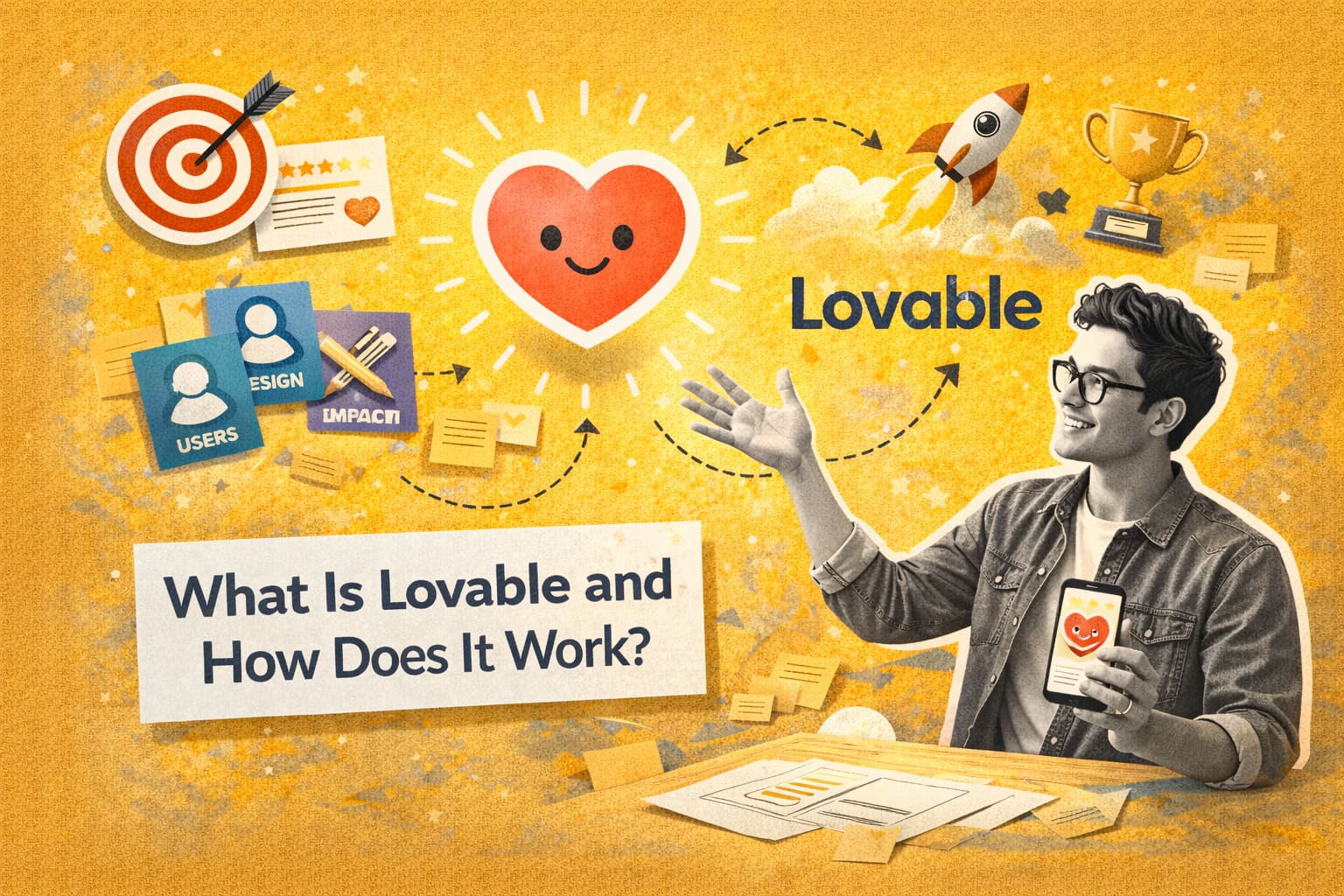
In the rapidly evolving landscape of 2026, the barrier between a visionary idea and a functional software product has never been thinner. While the previous years were defined by the rise of simple 'no-code' website builders and rudimentary chat-to-code interfaces, we have entered an era of true generative software development. At the forefront of this revolution is Lovable, an AI-powered full-stack engineer that has redefined how founders, product managers, and enterprise teams approach rapid development.
Unlike the brittle low-code tools of the early 2020s, Lovable represents a shift toward 'lovable' software—products that aren't just functional but are aesthetically pleasing, highly performant, and built on professional-grade codebases. For anyone looking to move from concept to a web app development milestone in record time, understanding the mechanics, strengths, and strategic applications of Lovable is essential. This platform isn't just a shortcut; it's a paradigm shift in how we conceive, build, and scale digital experiences in a world where speed is the ultimate competitive advantage.
What Exactly is Lovable?
Lovable is a generative development platform designed to turn natural language descriptions into complete, production-ready web applications. It isn't just a code assistant like GitHub Copilot; it is an autonomous agent capable of handling the entire lifecycle of a frontend and backend build. By 2026 standards, Lovable has separated itself from the pack by focusing on the 'Full Stack Experience'—integrating UI design, logic, and database management into a single conversational flow.
At its core, the platform leverages advanced Large Language Models (LLMs) specifically tuned for the modern tech stack—primarily React, Tailwind CSS, and sophisticated backend integrations like Supabase. The philosophy behind the tool is reflected in its name: creating software that users actually want to use, rather than the clunky 'franken-apps' often produced by older no-code tools. It bridges the gap between a technical co-founder and a DIY builder, providing a middle ground where professional architectural patterns meet the accessibility of natural language.
The Shift from No-Code to AI-Generated Code
To understand Lovable, one must understand its place in the evolution of software creation. In the past, you had two choices: drag-and-drop builders that were easy but limited, or custom coding that was powerful but slow and expensive. Lovable introduces a third path. It generates clean, readable, and extensible code that a human developer can take over at any time, bridging the gap between ai prototyping and professional engineering.
Traditional no-code platforms often hide the code behind a proprietary interface, creating 'platform lock-in.' Lovable flips this script. By exporting standard TypeScript and React code, it ensures that your intellectual property is portable. This is a critical distinction for startups that need to prove their technical viability to investors during mvp development.
How Lovable Works: The Architecture of 2026
The magic of Lovable lies in its multi-agent orchestration. When you give Lovable a prompt like 'Build a CRM for real estate agents with integrated lead scoring,' it doesn't just write a single script. It breaks down the request into its architectural components, much like a senior lead engineer would when planning a sprint.
1. The Design Engine (UI/UX)
Lovable interprets brand requirements and functional needs to build a responsive interface using Tailwind CSS and Shadcn UI components. This ensures that the application follows modern design tokens and accessibility standards. If you feel the design needs more polish, a simple ux audit can often be the basis for subsequent prompts to refine the layout. The engine doesn't just 'guess' what looks good; it applies established design systems to ensure consistency across pages.
2. The Logic Layer
Using React (and often frameworks like Vite), Lovable builds out the state management and routing. It understands how a user should flow through an application, handling things like authentication guards and data validation without the user needing to specify every 'if/else' statement. This layer is crucial for complex interactions, such as multi-step forms or real-time data filtering, which traditionally required deep JavaScript knowledge.
3. The Backend and Database Integration
As of 2026, Lovable’s deepest integration remains with Supabase (the open-source Firebase alternative). It can automatically architect PostgreSQL schemas, set up Row Level Security (RLS) policies, and establish edge functions. This means your application isn't just a pretty face; it has a robust, scalable spine.
Data Sovereignty and Lovable Cloud
While Lovable allows you to connect to your own Supabase instance for full ownership, the introduction of Lovable Cloud provides a managed environment for those who want a zero-config deployment path. You maintain the flexibility to choose between absolute control and absolute convenience.
4. Continuous Iteration via 'Chat-to-Modify'
One of the most powerful features is the ability to 'chat' your way through bugs or feature requests. If a button isn't working as expected, you simply tell the AI, and it analyzes the existing codebase, identifies the conflict, and applies a surgical fix. This makes it an ideal partner for teams undergoing product discovery where requirements change hourly based on user feedback or stakeholder meetings.
Key Use Cases for 2026
Lovable has moved beyond simple 'to-do list' demos. In the current market, it is being utilized for sophisticated business solutions that empower both small teams and large enterprises.
Minimum Viable Products (MVPs)
For startups, time-to-market is the only metric that matters. Lovable is the primary engine for mvp development, allowing founders to launch functional products in days rather than months. This speed allows for real market testing before committing to a massive capital raise. Instead of spending six months building a feature nobody wants, you can test it in a weekend.
Internal Business Tools
Many enterprises suffer from manual processes. Lovable allows department heads to build custom internal dashboards, inventory trackers, or HR portals that integrate with their existing APIs. In many cases, these apps are later enhanced through workflow automation to replace tedious manual data entry. It democratizes the ability to solve internal friction without waiting for the IT department's backlog to clear.
Rapid Prototyping for Agencies
Agencies use Lovable to show clients high-fidelity, interactive prototypes instead of static Figma files. Seeing a clickable, data-connected app in a pitch meeting is significantly more persuasive than showing a slide deck. It moves the conversation from "What if?" to "When can we launch?"
Validating Features in Existing Ecosystems
Even for established products, Lovable can be used to build 'side-car' applications to test new experimental features without cluttering the main production codebase. If the feature proves successful, the code generated by Lovable can be refactored into the main app. This reduces the risk associated with web app development in mature environments.
| Feature | Traditional Development | Lovable (2026) | No-Code (Legacy) |
|---|---|---|---|
| Speed | 3-6 Months to Launch | 3-7 Days to Launch | 2-4 Weeks to Launch |
| Cost | High Cost ($50k+) | Low/Moderate Cost | Low Cost |
| Scalability | Fully Scalable | Highly Scalable | Low Scalability |
| Ownership | Custom Code Base | Clean React/Tailwind | Proprietary Lock-in |
| Maintenance | Requires Dev Team | AI-Assisted | Platform Dependent |
Detailed Breakdown: Why Lovable is Gaining Massive Traction
The rise of Lovable isn't just about market hype; it's about solving the historical friction points of software engineering. Let's look deeper into why it's dominating the generative software space:
- Human-Readable Code — The code generated is standard TypeScript/React. This is crucial because it means you aren't locked into the platform. If you outgrow the Lovable interface, you can download the repository and host it on Vercel or Netlify independently. This is a massive win for it-outsourcing-team-as-a-service providers who might take over an AI-generated project to scale it.
- Speed of Iteration — The feedback loop is measured in seconds. You make a request, see the preview update, and tweak immediately. This 'live-coding' feel is revolutionary for non-technical founders. It removes the "translation layer" between a visionary's thought and the final execution.
- Deep Database Integration — While other tools struggle with persistent data, Lovable’s seamless handshake with Supabase handles the complexity of relational databases, which is often the biggest hurdle in modern development. It understands joins, foreign keys, and security roles better than most junior developers.
- Design Sensibility — Unlike earlier AI tools that produced 'ugly' interfaces, Lovable has a baked-in understanding of modern ux/ui design principles. It leverages the best components from libraries like Shadcn, ensuring that the apps look professional and unique out of the box, rather than generic.
- The 'Remix' Culture — In 2026, Lovable allows users to share templates and 'remix' existing applications. This community-driven approach means you rarely start from a blank page. You start from a proven architecture and modify it for your specific niche.
Pro Tip
To get the best results from Lovable, provide 'User Stories' rather than just technical commands. Instead of saying "Add a table," say "Create a dashboard where an admin can view, filter, and delete registered users while providing a visual summary of total revenue."
Limitations and Challenges: The Reality Check
Despite its power, Lovable is not a magic wand that replaces the need for strategic thinking or specialized engineering in all cases. Understanding these boundaries is what separates successful product owners from frustrated ones.
Architectural Complexity
While Lovable excels at building 'standard' web applications (SaaS, marketplaces, dashboards), it can struggle with highly specialized architectures. If you are building a custom video processing engine, a complex WebGL visualization for 3D modeling, or low-level system integrations, you will hit a wall. For these, a technical co-founder or a specialized dev team is still required to handle the heavy lifting.
The 'Last 10%' Problem
AI is excellent at getting you 90% of the way there. However, that final 10%—the specific edge cases, unique animations, or niche API integrations—can sometimes take multiple prompting attempts to get right. This is where consulting & mentorship becomes invaluable. A professional can step in and provide the specific prompt structure or manual code fix to bridge the final gap.
Prompt Engineering Dependency
The quality of the output is heavily dependent on the quality of the input. Users who lack a basic understanding of how software works may find themselves 'lost in translation' when the AI interprets a vague prompt in an unexpected way. Understanding technical concepts like "state," "props," and "relational data" helps you communicate more effectively with the AI.
Testing and Quality Assurance
Lovable generates code, but it doesn't always generate comprehensive unit tests or end-to-end testing suites automatically. As an application grows in complexity, the risk of regression (where fixing one thing breaks another) increases. In 2026, we still recommend a human-in-the-loop for final QA before any major production release or scaling phase.
Lovable in the Strategic Product Lifecycle
At Rethink Lab, we view Lovable not just as a tool, but as a catalyst for a more efficient product lifecycle. It fits into a broader product strategy & roadmapping process by accelerating the prototyping phase and reducing initial capital expenditure.
Phase 1: The 'Discovery' Build
During the initial product discovery phase, we use Lovable to build functional prototypes within hours. This allows stakeholders to interact with the 'soul' of the product immediately. If the concept fails to resonate with users, we’ve only lost a few hours of work, not a multi-month development budget.
Phase 2: The Lovable MVP
Once the concept is proven, we build the MVP using Lovable to establish the core features—user auth, CRUD (Create, Read, Update, Delete) operations, and primary UI. This MVP is then launched to a group of beta testers. The speed here allows us to respond to user feedback in real-time, often shipping updates while the user is still on the call.
Phase 3: AI-Enhanced Scaling
As the user base grows, we might shift to ai-automation to handle things like customer support bots or automated data processing within the app. We continue to use Lovable to rapidly deploy requested features from the user feedback loop, maintaining high agility.
Phase 4: Professional Hand-off and Extension
If the product reaches a certain scale of complexity or requires specific security certifications (like HIPAA or SOC2), our engineers take the 'Lovable-generated' repository and perform a deep refactor. We optimize performance, add enterprise-grade security layers, and set up CI/CD pipelines. Because the code is clean and standard-compliant, this transition is seamless.
Avoiding 'Prompt-Debt'
Much like technical debt, "prompt-debt" happens when you keep adding features via chat without occasionally cleaning up the logic. If you notice the AI getting confused or the app slowing down, it's time for a developer review to clean up the underlying architecture.
Comparison: Lovable vs. Competitors in 2026
The market for generative software is crowded, but Lovable maintains a specific niche by focusing on the 'Full Stack' rather than just UI components. Here is how it compares to other leaders in the space:
- Lovable vs. V0 (Vercel): — V0 is incredible for UI components and frontend 'vibes.' It generates beautiful React components, but it doesn't build your database or manage your backend logic. Lovable provides a more comprehensive 'full-stack' experience by managing the Supabase integration and state management.
- Lovable vs. Cursor: — Cursor is an IDE (Integrated Development Environment) for developers. It requires you to know how to code. Lovable is a platform for builders. You can use Lovable without ever opening a code editor, although knowing code helps you prompt better.
- Lovable vs. Bubble: — Bubble is a leading 'walled garden' no-code tool. It's powerful, but the learning curve is steep, and you are locked into their proprietary hosting and language. Lovable gives you the speed of no-code with the freedom of custom code.
- Lovable vs. Bolt / Windsurf: — These are newer 'orchestration' agents. While powerful, Lovable tends to lead in the "visual" and "UX" execution because it integrates design systems more natively into its generation process.
The Role of Design in a Lovable World
Just because an AI can build an app doesn't mean it should build it without a plan. A web redesign or a new build still requires a strong visual identity and a clear user journey. In 2026, the 'Design-to-Code' pipeline has become nearly instantaneous, which places More emphasis on the 'Design' part of the equation.
Professionals now use Lovable to handle the 'assembly' of the architecture, but they rely on ux/ui design experts to define the brand voice, the emotional resonance of the color palette, and the subtle interactions that make an app feel premium.
"The tool builds the house, but the architect makes it a home."
Lovable is the 'builder,' but you still need the 'architect.' Without a clear product strategy, you risk building a very polished, high-performance version of a product that nobody actually wants to use. Speed is only valuable if you are moving in the right direction.
Future Outlook: Where is Generative Software Heading?
As we look toward the later half of the decade, we expect Lovable and tools like it to evolve in three major areas:
- Multi-Platform Support: — While currently focused on web apps, the jump to native mobile app development via React Native is the logical next step. Imagine describing a mobile app in the morning and having it in TestFlight by lunch.
- Autonomous Optimization: — Future iterations will likely proactively suggest performance improvements, accessibility fixes, or SEO optimizations without the user even asking. The AI will monitor the app's performance and suggest 'surgical' updates to the code to keep it running smoothly.
- Collaborative AI-Human Workspaces: — We will see environments where multiple humans and multiple AI agents work on the same codebase simultaneously. The AI will handle the 'drudge work' (API boilerplate, documentation, testing) while the humans focusing on high-level creative direction and business logic.
Why 'Lovable' is the Key Term
In a world flooded with generic AI content and apps, the products that win are those that are 'lovable.' They solve a real problem, they are delightful to use, and they feel 'human.' Lovable (the tool) provides the efficiency to let you, the creator, focus on those human elements. It removes the technical friction and leaves the creative spark.
Getting Started with Lovable: A Practical Checklist
If you are ready to start your first project, follow this 2026 roadmap to ensure your project is built on a solid foundation:
- Define Your Core Value Prop — What is the one thing your app must do? Avoid feature creep in the first 24 hours. Focus on the core 'happy path.'
- Set Up Your Supabase Account — Having your own backend ready before you prompt will make the process much smoother and give you immediate ownership of your data.
- Draft a 'Prompt Document' — Don't just wing it. List your pages, your data fields (e.g., 'User name,' 'Email,' 'Project Title'), and your primary user flows on a notepad first.
- Iterate in Small Bursts — Don't try to build the whole app in one prompt. Build the login, then the dashboard, then the settings page. Test each component before moving to the next.
- Use reference UI — If you like a specific look, describe it using design terminology (e.g., "Use a minimalist Bento-grid layout with soft shadows and high-contrast typography").
- Seek Professional Guidance — If you get stuck or want to ensure your architecture is scalable for a large user base, consider consulting & mentorship to provide the oversight needed for a professional launch.
Conclusion: The Era of Democratic Development
Lovable is not just another utility in the developer's toolbox; it is a fundamental shift in how we conceive and construct digital products. By lowering the cost and time of web app development, it empowers a new generation of creators to bring their ideas to life. In 2026, the question is no longer 'Can we build it?' but 'What should we build?'
The technology has reached a point where the only limit is our imagination. Whether you are a solo founder looking for a technical co-founder alternative or an established business seeking rapid development of new internal tools, Lovable offers a path to quality that was previously inaccessible to most.
At Rethink Lab, we are excited to guide our partners through this new landscape. By combining the raw speed of Lovable with our deep expertise in product strategy and ux/ui design, we help you build products that aren't just functional—they are truly lovable. The era of the 'lovable' app is here—it's time to start building.