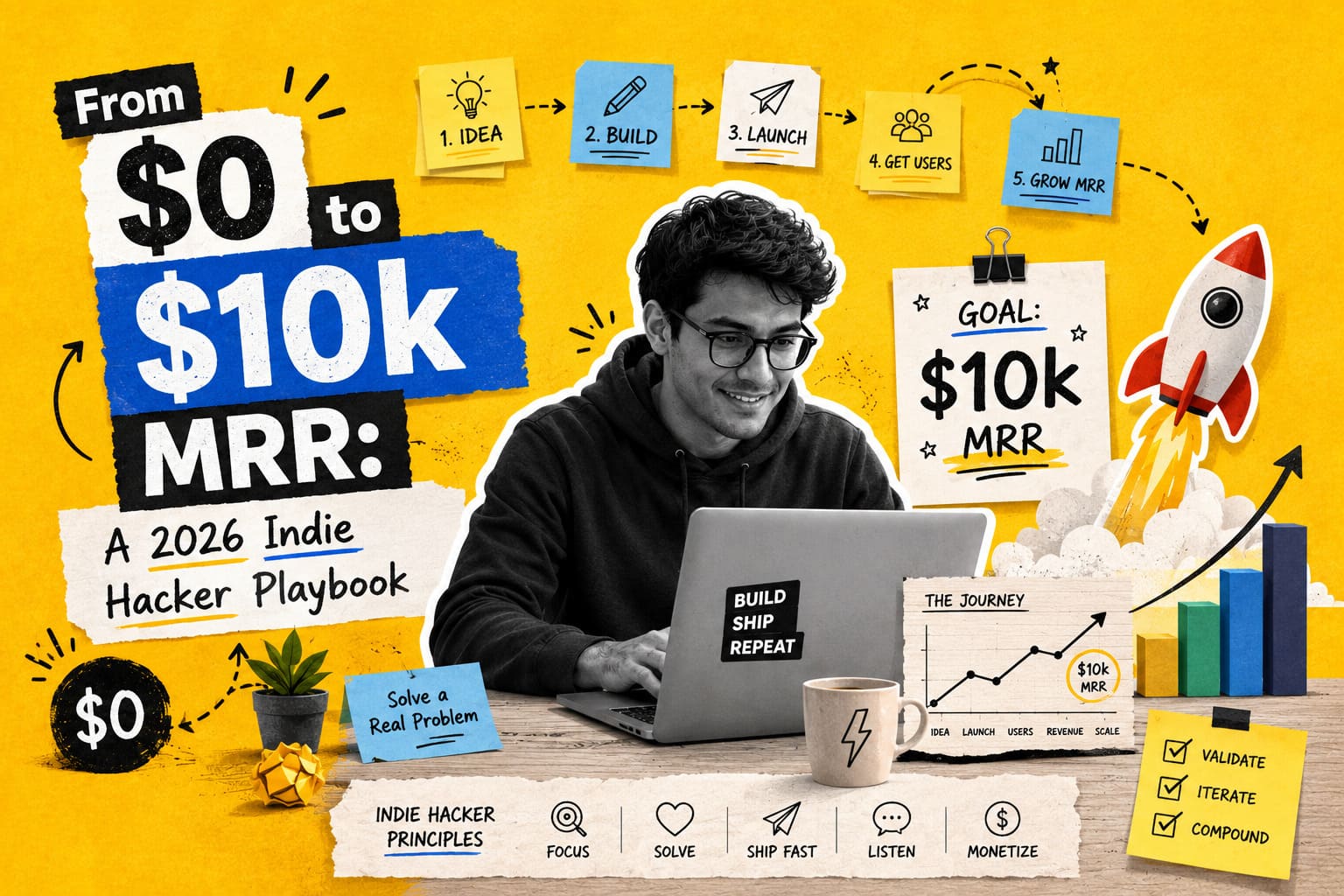
Building a profitable software business as a solo founder has never been more accessible—yet, paradoxically, never more difficult. As we navigate 2026, the landscape of indie hacking has undergone a seismic shift. The barriers to entry regarding technical execution have crumbled thanks to generative AI, but the barriers to entry regarding market attention have reached an all-time high. To hit that coveted $10,000 Monthly Recurring Revenue (MRR) milestone, you can no longer rely on being a 'coding wizard.' You must become a strategic architect of value.
In this comprehensive playbook, we will break down the exact strategies, mental models, and technical stacks required to take an idea from absolute zero to a sustainable $10k MRR business in the current year. Whether you are looking for MVP development advice or a long-term growth strategy, this guide covers the full spectrum of the modern indie hacker journey.
1. The Biggest Mindset Shift in 2026
In the early 2020s, speed was a competitive advantage. If you could build a CRUD (Create, Read, Update, Delete) app faster than the next person, you won. In 2026, speed is the baseline. AI agents and high-level abstractions mean that everyone can build quickly. If speed is no longer the moat, what is?
- Distribution is Infrastructure — In 2026, you don't build a product and then find an audience; you identify an audience and then build a product that solves their specific friction. Coding is now the cheapest part of the process.
- Small is the New Big — The 'Unicorn or Bust' mentality is dead for indie hackers. A 10k MRR business with a 90% profit margin is more valuable to a solo founder than a 100k MRR business with high burn and venture debt. Profitability is the ultimate flex.
- Solo Founders as Aggregators — With AI automation, a single person can now perform the tasks that previously required a team of five. You are no longer just a developer; you are an editor of AI-generated output across marketing, sales, and engineering.
"The most successful founders in 2026 aren't those who write the cleanest code, but those who understand the psychology of their users and can leverage AI to scale their personal output."
2. Stop Chasing 'Startup' Ideas
Most indie hackers fail because they try to build the next social network or a revolutionary 'game-changer.' To reach $10k MRR, you don't need a revolutionary idea; you need a painful, boring problem.
Finding Painful and Recurring Problems
- Manual Workflows — Look for people using Excel or Google Sheets to manage something complex. If a spreadsheet has 20 tabs and five people updating it daily, there is a SaaS opportunity there.
- Agency Pain Points — Digital agencies often have high-touch, repetitive tasks. Tools that automate reporting, client intake, or asset management are goldmines.
- Creator Economy Fatigue — Creators are overwhelmed by fragmented tools. Any tool that provides a unified workflow automation logic for content distribution is highly sellable.
- Local Business Inefficiencies — Dentists, plumbers, and lawyers still use antiquated software. They have high budgets and a low tolerance for friction.
The 'Boring' Opportunity Framework
Instead of asking "What would be cool?", ask "What is someone currently paying for that they hate?" or "Where is the most expensive human labor currently being wasted?" Targeting these niches allows you to charge more and face less competition from Silicon Valley giants.
3. Validate Before You Build
The graveyard of failed SaaS projects is filled with beautiful code for products nobody wanted. In 2026, product discovery is the most critical phase of your journey.
- The Fake Door Test — Create a high-fidelity landing page using tools like Framer or Webflow. Describe the solution, list the pricing, and have a 'Get Started' button that leads to a waitlist or a 'Coming Soon' message. Track the conversion rate.
- Pre-selling via Cold Outreach — Reach out to 50 potential users on LinkedIn. Offer them a 'Founding Member' lifetime deal for $200 before you've written a line of code. If you can't sell it when it's just a promise, you probably won't sell it when it's a product.
- Community Feedback Loops — Identify where your users hang out (Reddit, Discord, specialized forums). Don't pitch your product; ask about their problems.
7 Validation Questions to Ask Potential Users
- What is the hardest part about [Process X] for you today?
- How much time/money do you spend on this monthly?
- What have you tried to do to solve this already?
- Why didn't those solutions work for you?
- If this problem was solved, how would your daily routine change?
- Who else in your organization is affected by this?
- Is there a budget allocated for tools in this category?
According to research by Harvard Business Review, the lack of market need is still the #1 reason for failure. Skip the code; find the need.
4. Build Your MVP Fast (The 2026 Way)
In 2026, your Minimum Viable Product (MVP) should take weeks, not months. The goal is to reach the 'Aha moment' for one specific user journey. Anything else is bloat.
- AI-Powered Development — Use tools like Cursor and Lovable to generate boilerplate and complex logic. Focus your manual effort on the unique value proposition.
- Lean Backend — Use Supabase or Firebase to handle authentication and databases without managing servers. Focus on the UX/UI design to ensure the first impression is professional.
- The 'One Feature' Rule — Your MVP should do exactly one thing exceptionally well. If you are building a social media scheduler, don't build analytics, team permissions, or AI image generation yet. Just build the scheduler.
| What to Keep in MVP | What to Cut from MVP |
|---|---|
| Core Value Loop | Advanced Analytics |
| Frictionless Auth | Dark Mode Toggle |
| Basic Billing | Referral Programs |
| Direct Support Link | Complex Permissions |
| Responsive Design | Native Mobile Apps |
Build in Public
Share your progress daily on X (Twitter) or LinkedIn. It builds a built-in feedback loop and creates a sense of accountability. Users love to see the 'behind the scenes' of a building process.
5. Your First 10 Users Matter More Than 10,000 Visitors
Growth at the $0 to $1k MRR stage is a manual process. You don't need scalable marketing; you need unscalable relationships. These first ten users will define your product roadmap.
- Manual Onboarding — Don't let users sign up and figure it out. Offer a 15-minute Zoom call to set it up for them. This gives you front-row seats to their confusion and friction points.
- Founder-Led Support — In the beginning, you are the support team. Respond to tickets in minutes. This level of service creates 'super-fans' who will promote you for free.
- Tight Feedback Loops — If three users ask for the same small tweak, build it and ship it the same day. Show them that their input directly shapes the tool. This creates a moat of loyalty that bigger companies can't compete with.
6. Distribution Is the Real Moat
If you build it, they will not come. In 2026, the internet is too noisy for 'build it and they will come' to work. You need a dedicated distribution strategy.
SEO for Indie Hackers
Search Engine Optimization is no longer just about keywords; it's about being the most helpful resource for a specific intent. Focus on 'Long-tail' keywords. Instead of 'CRM,' aim for 'CRM for freelance interior designers in New York.' Smaller volume, higher conversion. For technical sites, a UX audit can ensure that your content is actually reachable and readable by both humans and bots.
Content-Driven Growth
- X/Twitter & LinkedIn — These platforms are the current engines of the indie hacker movement. Share lessons learned, revenue screenshots, and 'how-to' guides related to your niche.
- Programmatic SEO — Create template-based pages that serve thousands of niche queries. For example, if you build a design tool, create pages for 'Design ideas for [Niche A]', 'Design ideas for [Niche B]', etc.
- The 'Toolbox' Strategy — Build a free side-tool that solves a tiny part of the problem. A free PDF compressor can lead people to your full-featured document management SaaS.
According to Statista, the SaaS market is projected to grow significantly through 2026, but the competition is also scaling. To stand out, you must own your distribution channel.
7. The Fastest Path to $1k MRR
Getting to $1k MRR is about proving that your product is worth paying for. The biggest mistake is offering a free tier too early.
- Charge from Day One — Free users are often the most demanding and the least likely to provide constructive feedback that leads to revenue. If someone won't pay $10, they don't really have the problem you think you're solving.
- The Service + SaaS Hybrid — If your software automates a task, offer a 'Done-For-You' service for $500/month while the software is still maturing. This funds your development and keeps you close to the user's needs.
- High-Value Niche Focus — It is much easier to find 20 customers paying $50/month than 200 customers paying $5/month. Aim for business tools where the value is clear (saving time or making money).
Example High-Margin Models in 2026
- AI Workflow Tools — Connecting disparate APIs to automate a specific business process (e.g., automated legal discovery for small firms).
- Micro-SaaS for Platforms — Apps for the Shopify, Slack, or Salesforce ecosystems. These platforms provide the audience for you.
- Internal Utility Tools — Tools that help remote teams manage culture, security, or compliance.
8. Scaling from $1k to $10k MRR
This is where the transition from 'side project' to 'business' happens. At this stage, you are optimizing what already works.
- Reducing Churn — Once you have 50+ users, retention is more important than acquisition. If you lose 10% of your users every month, you'll hit a growth ceiling very quickly. Use technical co-founder level oversight to ensure your infrastructure is stable and performant.
- The Engineering-as-Marketing Flywheel — Continue building small, free tools that funnel into your main product. These tools act as permanent, appreciating assets for your SEO.
- Referral Loops — Give your current users a reason to bring in new ones. This doesn't have to be cash; it could be free credits, extra storage, or early access to new features.
What Not To Do
- Raising Capital too Early: Don't give up equity to solve a problem that just requires more sales calls. VC money often kills indie hacker businesses by forcing 'growth at all costs.'
- Premature Scaling: Don't hire a marketing agency or a full-time developer until you have hit at least $5k MRR and have a clear, repeatable process for acquiring customers.
9. The 2026 AI-Powered Indie Hacker Stack
Efficiency is the name of the game. A modern stack should minimize maintenance and maximize development speed.
- Product Development: — Supabase (Database/Auth), Next.js (Frontend/Backend), Vercel (Deployment).
- AI Integration: — OpenAI API or Claude (Anthropic) for logic processing; LangChain for chaining complex AI tasks.
- Design & UX: — Framer for rapid landing page iteration; Figma for core product design.
- Marketing & SEO: — Ahrefs for keyword research; Plausible Analytics for privacy-friendly tracking.
- Automation: — n8n or Zapier for connecting internal workflows without writing custom glue code.
10. Mistakes That Kill Indie Hackers Early
- Solving a Personal 'Fancy' Instead of a Market 'Need' — Just because you want a specialized Todo list doesn't mean the world needs another one. Check the market first.
- Underpricing — The 'race to the bottom' is a losing game. If your tool provides $1,000 of value, don't charge $9/month. Low prices attract low-quality customers.
- Ignoring the 'Boring' Stuff — You must care about taxes, legal structure, and data privacy (GDPR/CCPA) from a reasonably early stage. Using consulting & mentorship can help you navigate these hurdles without wasting months of time.
- Over-engineering — Don't build a microservices architecture for 10 users. A monolith is fine. In fact, in 2026, a monolith is often faster and cheaper to maintain.
11. Case Study: The Path of 'FormFlow AI'
Let’s look at a hypothetical (but realistic) 2026 success story: FormFlow AI, a tool that automatically categorizes and prioritizes customer support tickets using LLMs.
- Discovery: — The founder noticed that small Shopify stores were overwhelmed by 'Where is my order?' emails during the holidays.
- Validation: — They posted a manual 'I will categorize your emails for $50/week' offer on a Shopify forum. 5 people signed up instantly.
- MVP: — Built a simple tool using AI prototyping that connected to Gmail and tagged emails based on 5 categories. It took 10 days to build.
- First $1k: — Reached by cold DMing Shopify store owners who were complaining about support times on Twitter/X.
- The Move to $10k: — Built a 'Free Support Response Time Calculator' that went viral on LinkedIn. This led to a flood of organic traffic. They raised prices to $99/month and introduced a 'Pro' tier for $249/month.
12. The New Definition of Success
Success in 2026 is not about an exit; it’s about Freedom.
- Leverage over Labor: — Using AI to do the work of 10 people.
- Equity over Salary: — Owning 100% of a cash-flowing asset.
- Optionality: — Having the choice to work on what you want, when you want.
Profitability is the only metric that guarantees this freedom. By focusing on $10k MRR, you are creating a 'Basecamp' for your life—a stable platform from which you can choose to scale higher or enjoy the view.
Final Thoughts
The journey from $0 to $10k MRR is as much a psychological battle as it is a technical one. You will face weeks of zero growth. You will face bugs that seem impossible to fix. You will face 'Launch Fatigue.'
But in 2026, the tools at your disposal are more powerful than they have ever been. You have the ability to build, market, and scale a global business from your laptop. Start before you feel ready. Launch smaller than you think is respectable. Learn faster than the competition. Momentum beats perfection every single time.
Need help defining your roadmap or building that first version? At Rethink Lab, we specialize in helping founders navigate this exact journey. Whether you need a full product strategy & roadmapping session or deep technical support, we are here to help you build the future.