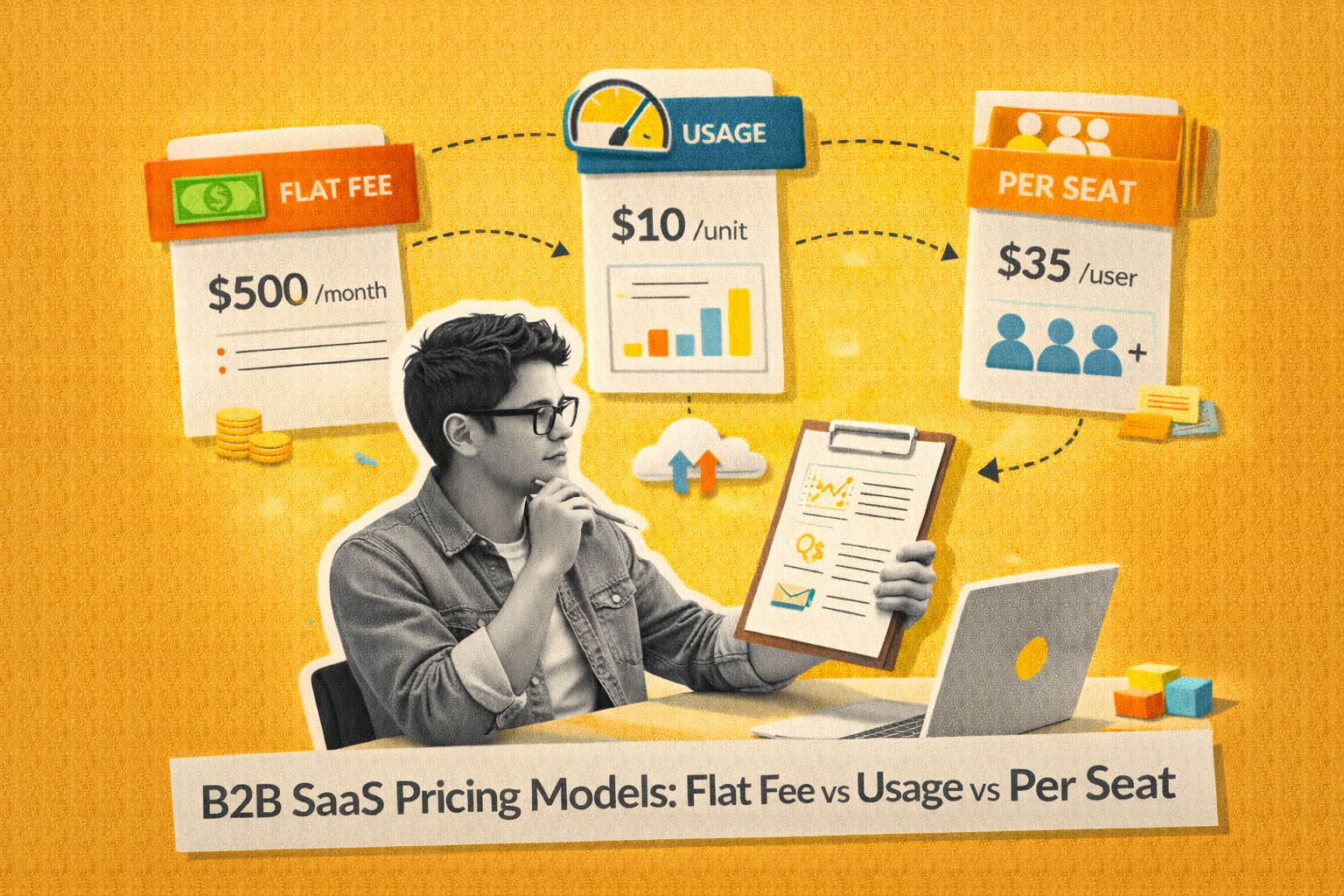
In the hyper-competitive landscape of 2026, the success of a B2B SaaS product is no longer determined solely by its feature set or the elegance of its code. Increasingly, the ceiling of a company’s growth is defined by its monetization strategy. Choosing between a flat fee, usage-based, or per-seat pricing model is one of the most consequential decisions a founder or product leader can make. It impacts everything from your Customer Acquisition Cost (CAC) and Lifetime Value (LTV) to your engineering architecture and internal workflow automation needs.
As we navigate the current software-as-a-service climate, we are seeing a massive shift toward value-aligned pricing. Traditional models are being scrutinized by increasingly savvy procurement teams who demand transparency and ROI. This comprehensive guide breaks down the mechanics, psychology, and strategic implementation of the three most dominant SaaS pricing models in 2026 to help you find the absolute sweet spot for your venture.
The Evolution of SaaS Pricing in 2026
For nearly a decade, the 'Per Seat' model reigned supreme, largely because it was easy for sales teams to explain and for CFOs to budget. However, as AI and AI automation continue to integrate into core business processes, the 'human-as-the-user' metric is breaking down. If a bot or an automated agent is doing the work of ten people, charging per seat becomes a race to the bottom for the vendor.
Today, modern SaaS companies are adopting more sophisticated hygiene. They aren't just picking a plan; they are conducting deep product discovery to understand which metric most closely correlates with the customer's perceived value. If your customer gets value from the number of emails sent, why charge them based on the number of administrators logged into the dashboard?
According to recent SaaS industry benchmarks from OpenView, companies that align their pricing with a 'value metric' grow 30% faster than those that use arbitrary flat rates. This alignment is the core of 2026's most successful GTM (Go-To-Market) strategies.
1. Flat Fee Pricing: The Power of Simplicity
Flat fee pricing, often called 'fixed-rate pricing,' involves offering a single product at a set price per month or year. It is the antithesis of the complex, multi-tiered enterprise contracts we often see in the market.
Why Startups Choose Flat Fees
- Predictability for Customers — In 2026, budget stability is a high priority for mid-market firms. They know exactly what bill to expect every month.
- Easier Sales Cycle — There is no negotiation over seats or usage credits. The buyer either wants the solution at that price or they don’t.
- Operational Simplicity — Your billing logic is simple. You don't need complex telemetry or real-time web app development hooks to track every API call.
The Downsides of Fixed Rates
While simple, flat-fee pricing often leaves money on the table. Small startups pay the same as massive corporations, leading to a situation where your most intensive users are actually your least profitable if they consume significant server resources.
The Scaling Trap
If you offer an 'unlimited' flat fee, beware of 'Power Users' who might drive your infrastructure costs above the monthly subscription price. Always define acceptable use policies in your terms of service.
When to Use Flat Fee Pricing
Flat fees work best for 'Utility' apps—tools that perform a specific task where the value doesn't scale linearly with the number of users. Think of a security plugin for a website or a simple UX audit automation tool. If your target market is small businesses (SMBs) who are highly price-sensitive, a simple flat fee can reduce friction during the initial sign-up.
2. Usage-Based Pricing: The Rise of 'Pay-As-You-Go'
Usage-based pricing (UBP) is the breakout star of the 2026 economy. This model charges customers based on their consumption of a specific resource—data processed, messages sent, minutes recorded, or API calls made.
The Psychology of Usage Pricing
Usage-based models remove the 'barrier to entry.' A customer can start with a very low investment (low risk) and scale their costs as they scale their success. This creates a natural partnership between the vendor and the client: you only get paid more when they use the product more.
- Scalable Revenue — As your customers grow, your revenue grows automatically without the need for a sales intervention.
- High Retainability — Because customers only pay for what they use, they are less likely to cancel during slow months, reducing churn compared to high-fixed-cost models.
Implementation Challenges
Usage-based pricing is technically demanding. It requires robust mobile app development or web infrastructure that can track events in real-time and feed them into a billing engine like Stripe or Chargebee.
| Feature | Flat Fee | Usage-Based |
|---|---|---|
| Revenue Predictability | High | Moderate |
| Barriers to Entry | Moderate | Low |
| Integration Complexity | Low | High |
| Upsell Effort | High | Automatic |
Case Study: The API Economy
Look at companies like Twilio or AWS. Their entire growth engine is built on usage. In 2026, many B2B SaaS companies are moving toward a 'Hybrid Model'—a base flat fee to cover hosting and support, plus a usage fee for heavy lifting. This ensures a floor for your revenue while maintaining an uncapped ceiling. If you are building a product that relies heavily on AI prototyping, usage-based pricing is often the only way to protect your margins against high GPU costs.
3. Per-Seat (Per-User) Pricing: The Legacy Giant
Despite the criticism, per-seat pricing remains the most common model in B2B SaaS. It is the logical choice for collaborative tools where the value is derived from how many people are interacting inside the platform.
Why Per-Seat Persists
- Linear Scaling — It’s easy to understand that 10 users cost 10x more than 1 user.
- Budget Friendly — Most department heads have budgets allocated by headcount. If a team grows from 20 to 30 people, the software budget naturally grows with it.
- Revenue Stability — Unlike usage, which can fluctuate wildly month-to-month, seat counts tend to stay stable or grow slowly.
The Problem with 'The Ghost User'
The biggest risk in 2026 is the 'Inactive Seat.' If a company is paying for 100 seats but only 20 people log in, the procurement team will eventually flag this as 'shelfware' and demand a massive downgrade or cancel entirely. To combat this, leaders in the space are offering 'Active User' pricing, where you only pay for seats that actually logged in during the billing cycle.
Driving Adoption
If you use per-seat pricing, your UX/UI design must be world-class. If the tool is hard to use, people won't log in, seats will go unused, and your renewal is at risk. High adoption is the best defense against churn.
Optimizing Per-Seat Tiers
Most per-seat models use tiers (e.g., Basic, Pro, Enterprise).
- Basic — Minimal features for the individual.
- Pro — Collaboration features (comments, sharing, team folders).
- Enterprise — Security features (SSO, SAML, Audit Logs).
If you're unsure which features belong where, a technical co-founder can help bridge the gap between user needs and engineering feasibility.
4. Comparing the Models: A Strategic Framework
Choosing a model isn't just about what's trendy; it depends on your product's core value proposition. Let's look at how to choose based on your business type.
The 'Value Link' Test
Ask yourself: what is the one thing the customer does that makes them say 'this was worth it'?
- If they say 'I saved 10 hours of manual work,' maybe charge per hour or per task (Usage).
- If they say 'Our whole team is finally on the same page,' charge per team member (Per Seat).
- If they say 'I just need this tool to work in the background 24/7,' charge a fixed rate (Flat Fee).
Hybridization: The 2026 Gold Standard
Many successful platforms are now using a 'Three-Part' pricing structure:
- Platform Fee — A base flat fee to access the software.
- User Fee — A small fee per seat for collaboration and permissions.
- Usage Overages — A fee for exceeding a certain threshold of data or actions.
This captures value from all angles. However, it requires a very clear product strategy and roadmapping phase to ensure the pricing isn't so complex that it confuses the customer.
5. Psychological Pricing Tactics for B2B
Beyond the model itself, how you present prices influences conversion rates. In the enterprise world, price is often equated with quality. If your software solves a $100k problem, pricing it at $10/month makes you look like a hobbyist tool, not an enterprise solution.
The Power of Tiering
Most B2B SaaS companies use three tiers. This utilizes the 'Decoy Effect' (or Center-Stage Effect). By placing your most profitable plan in the middle and making the high-end plan significantly more expensive, the middle plan looks like a bargain.
- The Free/Cheap Tier — Functions as a marketing channel for lead generation.
- The Growth Tier — Optimized for your 'ideal customer profile' (ICP).
- The Enterprise Tier — Highly customized, often 'Contact Sales' only.
Annual vs. Monthly Billing
In 2026, offering a 15-20% discount for annual billing is standard. This isn't just about cash flow; it's about reducing churn. A customer committed to a year has a much higher chance of reaching 'Product-Market Fit' with your tool than someone testing it for 30 days. This is especially true for complex MVP development projects that require a learning curve.
6. Engineering Your Billing Infrastructure
You cannot implement a sophisticated pricing model without the right technical foundation. Many startups fail because their 'billing logic' is hard-coded into their application code, making it impossible for marketing to change a price without a 2-week sprint.
Decoupling Billing from Core Logic
Use dedicated billing platforms like Stripe Billing or Paddle. These platforms handle the complexities of tax compliance (SaaS tax is notoriously difficult in 2026), currency conversion, and dunning management (recovering failed payments).
The Importance of Telemetry
If you choose a usage-based model, your telemetry system must be 'High-Cardinality.' You need to track exactly who did what and when. This data isn't just for billing; it's for product development. By analyzing which features are being 'used' to the point of hitting limits, you know exactly where to double down on web redesign or focus your feature updates.
// Example of a usage-tracking event in a modern SaaS architecture
async function trackUsage(customerId, eventType, quantity) {
  await billingProvider.ingestEvent({
    customerId: customerId,
    event: eventType,
    value: quantity,
    timestamp: new Date().toISOString()
  });
}
7. When to Pivot Your Pricing Model
Pricing is not a 'set it and forget it' task. As your product matures from an MVP to an established market player, your pricing should evolve.
Signs Your Pricing is Broken
- Your Sales cycles are too fast — You are likely too cheap.
- Customers never upgrade — Your tiers aren't offering enough 'expansion value.'
- Your CAC exceeds your LTV — You aren't capturing enough value from each customer to justify the cost of finding them.
- Procurement always asks for the same discount — Your 'list price' is too high, or you aren't communicating value effectively.
The Grandfathering Dilemma
When you change your pricing, deciding whether to keep old customers on their old rates (Grandfathering) is tricky. In 2026, the trend is to offer a 'Grace Period' (e.g., 12 months) before migrating them to the new plans. Keeping dozens of different legacy plans active indefinitely is a technical and support nightmare.
Leveraging Professional Consulting
Sometimes, an internal team is too close to the project to see the flaws. Bringing in consulting and mentorship can provide the external perspective needed to identify why customers are dropping off at the pricing page. It might be a pricing model issue, or it might be a UX/UI issue where the value isn't clearly displayed.
8. Data-Driven Decisions: The Role of A/B Testing
In 2026, you shouldn't guess your prices. You should test them. While B2B A/B testing is harder than B2C (due to lower traffic volumes), it is still possible.
- Test the Value Metric — Try offering one group a 'Per User' plan and another group a 'Per Project' plan.
- Test the Price Point — Use 'Van Westendorp Price Sensitivity' surveys to find the range of 'too expensive' and 'so cheap I doubt the quality.'
- Test the Packaging — Moving a feature from the 'Professional' tier to the 'Basic' tier can sometimes drastically increase top-of-funnel conversion.
According to research by ProfitWell (by Paddle), companies that review their pricing at least once every six months see a 10% higher ARPU (Average Revenue Per User) than those that don't.
9. Conclusion: Finding Your Competitive Edge
Choosing between flat fee, usage-based, or per-seat pricing isn't just a financial decision—it's a statement about your company's values and how you view your relationship with your customers. In 2026, the most successful SaaS products are those that lower the barriers to entry, align their growth with their customers' success, and remain flexible enough to adapt to a changing market.
If you're currently building or scaling a product and feel your pricing is holding you back, it might be time for a product discovery session to re-evaluate your value metrics. Whether you need a team for rapid development to implement these changes or a technical co-founder to guide your strategy, Rethink Lab is here to ensure your pricing model is an engine for growth, not a weight on your progress.
Ready to optimize your SaaS for the 2026 market? Get in touch with our team of experts today and let's build something extraordinary together.