
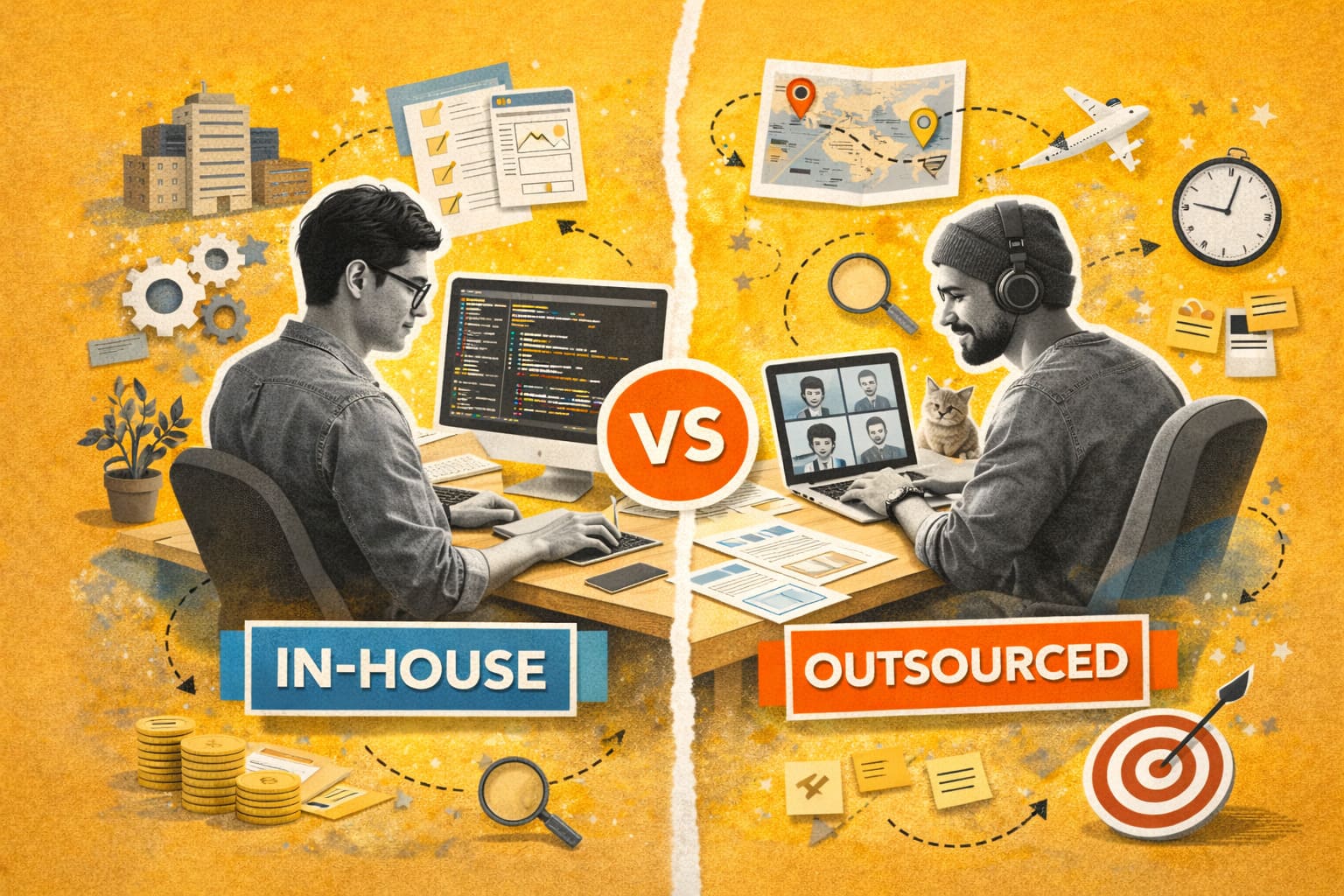
In the volatile landscape of the modern tech market, the decision of how to build your software product is often more consequential than what you are actually building. For founders and product leads, the dilemma usually boils down to a single high-stakes question: Do we hire an internal team or partner with an external agency? The choice between in-house vs outsourced development for startups isn't merely a line item on a budget spreadsheet; it is a strategic decision that affects your speed-to-market, your technical debt, and your ability to pivot when the market demands it.
At Rethink Lab, we have seen both sides of the coin. We’ve stepped in to rescue projects that stalled under the weight of slow internal hiring, and we’ve helped mature companies transition from outsourced models to robust internal teams. This guide aims to provide an exhaustive, 360-degree view of the factors involved, helping you determine which path aligns with your current stage of growth and your long-term vision.
The Real Cost of Building: Beyond the Hourly Rate
When startups compare in-house and outsourced models, they often fall into the trap of only looking at the monthly salary versus the agency invoice. This is a reductive approach that ignores the 'hidden' costs of employment. To make an informed decision, you must look at the Total Cost of Ownership (TCO) for your human capital.
The Hidden Costs of In-House Teams
When you hire a full-time developer, you aren't just paying for their code. You are paying for:
- Recruitment fees — Often 20-30% of the hire's annual salary if using a recruiter.
- Benefits and taxes — Health insurance, 401k matching, payroll taxes, and paid time off.
- Operational overhead — Office space, high-end hardware, software licenses (Slack, Jira, GitHub), and snacks.
- Training and retention — The cost of leveling up a junior developer or the 'churn cost' if a developer leaves after six months for a better offer.
The All-Inclusive Nature of Outsourcing
Outsourcing, particularly through a Rapid Development model, consolidates these costs. You pay a predictable rate that includes the developer's equipment, their management, and the infrastructure required to support them. While the hourly rate might look higher on paper, you bypass the administrative burden and the long-term liability of employment.
| Expense Category | In-House Team | Outsourced Agency |
|---|---|---|
| Recruiting | High (Time + Fees) | Low/Zero |
| Onboarding | 4-8 Weeks | 1-2 Weeks |
| Flexibility | Low (Hard to downsize) | High (Scalable) |
| Long-term ROI | High (IP Retention) | Moderate (Execution focus) |
| Management Overhead | High (Founder-led) | Low (Project Managed) |
Time-to-Market: The Startup’s Only Real Currency
For a startup, time is the ultimate limited resource. If you have secured seed funding, your 'runway' is a countdown clock. Finding, interviewing, and hiring a solo Senior Full-Stack Developer can take anywhere from three to six months in a competitive market. By the time they have their first PR (Pull Request) merged, a competitor using an outsourced team might already be on their second iteration of an MVP Development cycle.
Why Agencies Are Faster
Agencies function like a 'plug-and-play' ecosystem. Because they have established workflows, pre-built component libraries, and a roster of developers who have worked together before, the 'storming and norming' phase of team dynamics is skipped entirely.
Speed Tip
Don't hire for what you need in two years; hire for what you need to survive the next six months. If your product isn't live, you aren't learning from customers.
The Risk of the 'Hiring Freeze'
If you commit to in-house growth and the market shifts, you are stuck with a high burn rate that is difficult to reduce without devastating morale. Outsourcing allows for a 'burst' capacity: scale up significantly during the initial build and scale down to a maintenance crew once the product is stable. This elasticity is vital for preserving cash during the Product Discovery phase.
Risk Mitigation and Technical Debt
One of the loudest arguments in favor of in-house development is the 'knowledge silo' concern. The fear is that if an agency builds the product, the knowledge lives outside the company. While this is a valid concern, it is often mitigated by proper documentation and a transition plan.
The Danger of One In-House Developer
Many startups start with a single 'Rockstar' developer. This creates a massive 'Bus Factor' risk—if that one person leaves, your entire technical infrastructure is a mystery to whoever replaces them.
An agency provides a collective brain trust. If one developer on an agency team falls ill or moves on, the agency has the redundant capacity to swap in another expert without the project grinding to a halt. Furthermore, a Technical Co-Founder service can provide the high-level oversight needed to ensure that the code being produced is scalable and maintainable, regardless of who is writing it.
Quality Control and Blind Spots
In-house teams can sometimes develop 'tunnel vision,' becoming too attached to a specific architecture or toolset even when it’s no longer efficient. External agencies work across dozens of industries and tech stacks. They bring 'cross-pollinated' ideas—solutions they found for a FinTech app that can be applied to your E-commerce platform. This breadth of experience often leads to cleaner code and fewer architectural dead-ends.
Culture, Product Vision, and Intangibles
Where the in-house model truly shines is in the deep alignment with the company's mission. A full-time employee isn't just building a feature; they are living the brand. They overhear customer success calls in the office, they participate in all-hands meetings, and they feel the 'pain' of the user more acutely.
Building a Product-First Culture
If your product is highly experimental and requires daily, minute-by-minute pivots based on user feedback, an in-house team might be more responsive to the 'vibe' of the company. However, this level of agility can be replicated with an outsourced partner if you treat them as an extension of your team rather than a 'feature factory.'
The Hybrid Model: The Best of Both Worlds
Increasingly, the most successful startups are abandoning the 'either/or' binary in favor of a hybrid approach. This involves keeping a core of 'Product Mindset' leaders in-house while leveraging IT Outsourcing & Team-as-a-Service for the heavy lifting of development.
How the Hybrid Model Works
- In-House: — Product Manager and/or CTO. They own the roadmap, the vision, and the user experience.
- Outsourced: — Frontend developers, Backend engineers, and QA testers. They focus on execution and delivery.
- The Result: — The company maintains its intellectual property and vision while gaining the speed and cost-efficiency of an agency.
This model is particularly effective when you need specialized skills for a short period. For example, you might need AI Automation or complex Workflow Automation that your generalist in-house team isn't equipped to handle.
"A startup is a race against time. The goal isn't to build the perfect engineering department; it's to build a product that people need before the money runs out."
Assessing Your Needs: A Decision Framework
To help you decide which path to take, ask your leadership team these four questions:
- How unique is our technology? — If you are building a proprietary new encryption algorithm, keep it in-house. If you are building a marketplace, a SaaS, or a consumer app, an agency can likely do it faster.
- What is our current runway? — If you have less than 12 months of cash, the 3-month lead time for hiring an in-house team is a luxury you cannot afford.
- Is our product-market fit (PMF) proven? — If you are still in the AI Prototyping or MVP stage, stay lean and use an agency to test your hypotheses.
- What is our management capacity? — Do you have the bandwidth to manage 5 developers, handle their performance reviews, and manage their grievances? If not, let an agency handle the management overhead.
Maintaining Quality Across Models: The Role of Design
Regardless of which development route you choose, the 'bridge' between business and code is always design. Many startups fail because they focus on the 'how' (development) before the 'what/why' (design).
A solid UX/UI Design foundation ensures that your developers—whether in-house or outsourced—aren't wasting time building features that users don't want. If you already have a product and are seeing high churn, it might not be a development issue at all; you might need a UX Audit to identify where the friction lies.
Danger Zone
Don't outsource your thinking. You can outsource the writing of code, but you should never outsource the definition of your product's value proposition.
Long-Term Scalability and Transitioning
What happens when your startup grows? A common misconception is that if you start with an agency, you are 'locked in' forever. In reality, a professional agency will help you transition to an in-house team when the time is right.
The Transition Blueprint
- Architecture Documentation — Ensure every API endpoint and database schema is documented.
- Phased Handover — Hire your first in-house engineer and have them 'shadow' the agency for 4-8 weeks.
- Code Ownership — Ensure your contract clearly states that you own the IP and the repository from day one.
This transition usually happens around Series A or B funding, when the company has the capital to support a large permanent headcount and the product has stabilized enough that rapid pivots are less frequent.
Conclusion: Choosing Your Competitive Advantage
In the debate of in-house vs outsourced development for startups, there is no universal winner. The in-house model offers deep culture and long-term IP focus, but at the cost of high overhead and slow speed. Outsourcing offers incredible speed, flexibility, and access to specialized talent, but requires clear communication and a partnership mindset.
For most early-stage and growth-stage startups, the agency-led or hybrid model is the most rational choice. It preserves capital, maximizes speed, and allows the founders to focus on what they do best: finding customers and refining the vision.
If you are ready to stop worrying about hiring pipelines and start focusing on your product, it might be time for expert guidance. Whether you need a full MVP Development or a strategic Product Strategy & Roadmapping session, Rethink Lab is here to help you navigate the complexities of modern software building.
Don't let the technical hurdles of today stop you from building the company of tomorrow. Reach out to our team to discuss how we can accelerate your journey.