
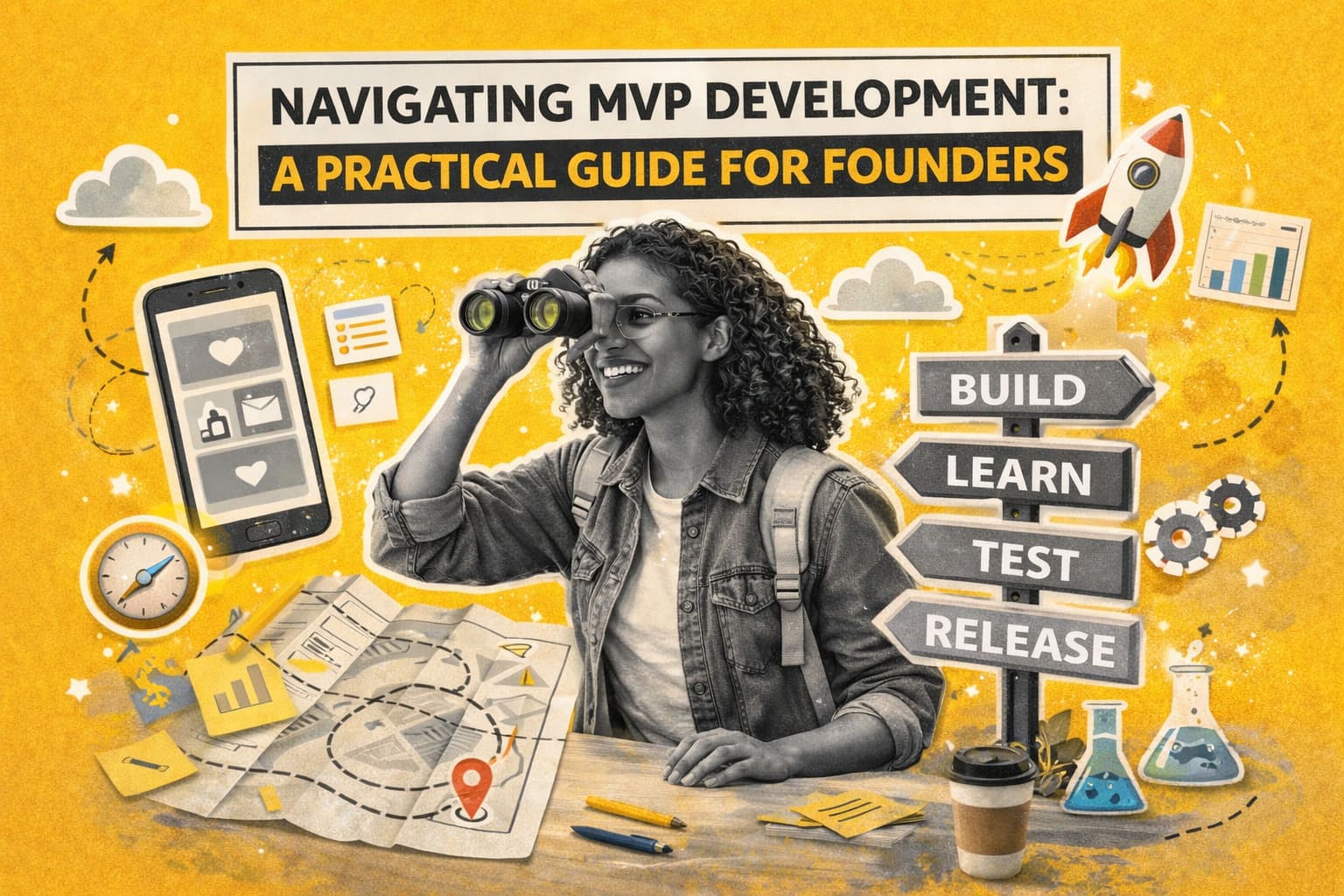
In today's fast-moving startup landscape, the difference between a market leader and a forgotten footnote often comes down to one thing: how quickly you can validate your idea with real users. An MVP (Minimum Viable Product) isn't just a stripped-down version of a dream product—it's a strategic tool for accelerated learning. The concept, popularized by Eric Ries in "The Lean Startup," has evolved from a tech buzzword into a survival requirement for modern founders.
Navigating the transition from an abstract idea to a functional product requires more than just coding skills; it demands a rigorous product strategy that balances speed, cost, and user value. This guide provides a comprehensive deep dive into the mechanics of MVP development, offering actionable frameworks for founders who are ready to stop guessing and start building.
Why MVPs Matter More Than Ever in a Hyper-Competitive Market
The primary goal of an MVP is to test fundamental business hypotheses. Every founder starts with a set of assumptions: "People have this problem," "People will pay for this solution," and "Users will understand how to use this interface." Without an MVP, you are essentially gambling your capital and time on these unverified assumptions. By shipping a minimum version of your product, you shift from a state of "guessing" to a state of "knowing."
The lean startup methodology has proven that founders who ship fast and iterate based on real feedback dramatically outperform those who spend months building in isolation. This is because market dynamics change rapidly. A feature that seemed essential six months ago might be redundant by the time you launch if a competitor beats you to the punch or if user behavior shifts.
The 80/20 Rule of Features
On average, 80% of a product's value comes from 20% of its features. An MVP is the search for that critical 20%.
At Rethink Lab, we believe the MVP is the ultimate risk-mitigation strategy. It allows you to:
- Minimize Wasted Resources — Avoid spending months of development hours on features that users ultimately ignore.
- Secure Early Adopter Buy-in — Build a community around your roadmap by letting early users influence the product's direction.
- Provide Proof of Concept — Make your seed round or Series A conversation much easier by showing real-world traction and usage data.
- Discover the "Killer Feature" — Often, the secondary feature you added on a whim becomes the primary reason people use the app.
The MVP Development Framework: A Structural Approach
Building an MVP isn't about cutting corners—it's about prioritizing ruthlessly. It requires a disciplined mindset to distinguish between what is "cool to have" and what is "mission-critical." At Rethink Lab, we utilize a structured four-pillar framework to guide founders through the murky waters of early-stage development.
1. Deep Problem Validation and Discovery
Before writing a single line of code or designing a single wireframe, you need to confirm that the problem you're solving is real, urgent, and worth paying for. Many founders fall into the "solution looking for a problem" trap. They build a beautiful piece of technology and then wonder why no one uses it. This is why product discovery is the most vital phase of any project.
To avoid building a product nobody wants, follow these validation steps:
- Customer Interviews — Talk to at least 20 to 50 potential users. Do not pitch your idea; instead, ask about their current workflows and frustrations. If they don't complain about the problem you're trying to solve without being prompted, it's not a burning pain point.
- Competitor Analysis — Map the existing solutions landscape. How are people solving this today? Even a messy Excel spreadsheet is a competitor. You need to understand why existing tools are failing them.
- Market Sizing — Ensure the opportunity is large enough to sustain a business. Use a Top-Down and Bottom-Up approach to estimate your Total Addressable Market (TAM).
- Pain Point Scoring — Rank problems by frequency (how often it happens) and severity (how much it hurts). The best MVPs target high-frequency, high-severity problems.
2. Feature Prioritization and Scope Creep Management
The most dangerous phrase in MVP development is "While we're at it, let's just add..." This leads to scope creep, which pushes back launch dates and consumes resources. To combat this, we recommend the MoSCoW method, a robust prioritization technique that forces hard decisions.
| Priority | Category | Description | Example |
|---|---|---|---|
| P0 | Must Have | Core value prop; product is non-functional without it. | Processing a payment in an e-commerce app. |
| P1 | Should Have | Important and adds value, but can wait 2-4 weeks. | Password reset or basic email receipts. |
| P2 | Could Have | Nice-to-have features that add polish or delight. | Dark mode toggle or social sharing buttons. |
| P3 | Won't Have | Explicitly out of scope for the initial launch. | Advanced AI-driven predictive analytics. |
The "Zebra" Test for Features
If you removed a feature, would the product still function? If yes, it's likely a P2 or P3. If no, it's a P0. Be brutal. If your MVP has more than 3-5 core features, you're probably building too much. Strip it down until only the skeletal essence remains.
"The best MVPs solve one specific problem exceptionally well, rather than addressing many problems poorly. This is often referred to as the 'Minimum Awesome Product' mindset."
3. Technical Architecture for Scalability and Speed
Choosing your tech stack is a pivotal decision. For most MVPs, the goal is speed to market and ease of iteration, not gold-plated engineering. At Rethink Lab, we typically lean toward high-productivity frameworks that allow for rapid development.
// Example: A lean API structure focusing on core entities
const routes = {
  auth: ["/login", "/register", "/verify-email"],
  transactions: ["/execute-payment", "/history", "/refund/:id"],
  userProfile: ["/get-profile", "/update-settings"],
};
Key architectural decisions for high-growth MVPs:
- Use Managed Services (BaaS/PaaS) — Don't build what you can buy. Use Stripe for payments, Auth0 or Firebase for authentication, and AWS or Vercel for hosting. These services handle the "undifferentiated heavy lifting."
- Start Monolithic — Microservices are a form of premature optimization for an MVP. They introduce complexity in networking and deployment that will slow you down. A well-structured monolith can scale significantly before needing to be broken apart.
- Pick "Boring" Technology — Use stable, well-documented languages like React, Node.js, and PostgreSQL. These have massive communities, meaning it's easier to find developers and solve bugs via documentation and community support.
- Sanitize Your Data Model — While the UI can be changed overnight, migrating a messy database is painful. Spend extra time ensuring your data relationships make sense from day one.
The "Deleteability" Principle
Code your MVP in a way that is easy to delete or refactor. Avoid highly coupled systems that make it impossible to pivot later.
4. Design & UX Essentials: The Utility-First Approach
Your MVP doesn't need to win a Webbys award, but it must be professional and usable. There is a "Trust Threshold" that your design must cross. If an app looks broken or amateurish, users will assume their data isn't safe. This is why a solid UX/UI design process is non-negotiable.
Focus on these non-negotiables:
- Consistent Navigation — Users should never feel lost. A standard sidebar or top-nav is better than a "revolutionary" new menu system that confuses people.
- Performance — Speed is a feature. A 100ms delay in response time can reduce conversion by 7%. Ensure your MVP loads in under 3 seconds.
- Mobile Responsiveness — Even for B2B tools, stakeholders often check apps on their phones during transit. A broken mobile layout signals a lack of quality.
- Clear CTA (Call to Action) — What is the one thing the user should do on this screen? Make it obvious with color contrast and whitespace.
If you already have a prototype or an early version of your product that isn't converting, consider a UX audit to identify where users are dropping off before you invest in more features.
Measuring MVP Success through Data and Friction
Once your MVP is live, the clock starts ticking. You are now in the "Build-Measure-Learn" loop. The biggest mistake founders make at this stage is looking at "vanity metrics" like total page hits or social media followers. Instead, you must focus on engagement, retention, and friction points.
Quantitative Metrics: The Hard Truth
| Metric | Meaning for an MVP | Target Milestone |
|---|---|---|
| Sign-up Conversion | Does the landing page copy resonate? | >7% of unique visitors |
| Activation Rate | Do they reach the "Aha!" moment? | >45% of sign-ups |
| D7 Retention | Is the product sticky enough to return? | >20% average |
| Churn Rate | Are people leaving for good? | <10% monthly |
| Time to Value | How fast can they complete the core task? | <3 minutes |
Qualitative Signals: The Human Element
Data tells you what is happening, but qualitative feedback tells you why.
- The "Must-Have" Survey — Ask your users: "How would you feel if you could no longer use this product?" If more than 40% say "very disappointed," you have achieved Product-Market Fit (PMF).
- Organic Referrals — Are users telling their friends without being prompted? This is the strongest signal of value.
- Support Tickets — If users are complaining about features they want rather than bugs they've found, you're on the right track. It means they care enough about the product to want it to be better.
"If users sign up but never return, you don't have a marketing problem; you have a value delivery problem. No amount of Facebook ads will fix a product that doesn't solve a core need."
Strategic Iteration: Turning Feedback into Growth
The MVP is just the starting line. Once you have data, the real work begins. This is where many founders lose their way, either by reacting too quickly to every single user request or by being too stubborn to change their original vision.
The Feedback Filter
Not all feedback is created equal. You must filter feedback through your long-term vision.
- The Power User — Feedback from someone who uses the tool every day is 10x more valuable than feedback from someone who logged in once.
- The Paying Customer — Feature requests from people willing to put a credit card down should always be prioritized over "free-tier" enthusiasts.
- The Silent Majority — Look at what people do, not just what they say. If 100 people say they want a calendar view, but nobody click-tracks the "coming soon" calendar button, don't build it.
Pivot vs. Persevere
Deciding when to pivot is the hardest part of the founder's journey.
- Pivot when: — Your CPA (Cost Per Acquisition) is consistently higher than your LTV (Lifetime Value), and your retention remains flat despite multiple UI updates.
- Persevere when: — You see a small "cohort" of users (even if it's just 5 people) who are obsessed with the product. Figure out what makes those 5 people different and find 5,000 more just like them.
Common MVP Pitfalls and How to Avoid Them
We have helped dozens of startups launch via MVP development, and we've spotted patterns in why some fail to gain traction. Avoid these common traps to keep your project on track.
1. Over-Engineering and Future-Proofing
Founders often worry about how the app will handle a million users before they even have ten. This leads to complex architectures that are hard to change.
// ❌ THE OVER-ENGINEERED TRAP (Avoid this in MVP)
class GlobalAnalyticsDispatcher {
  constructor() {
    this.drivers = [new SegmentDriver(), new MixpanelDriver(), new CustomWarehouse()];
    this.buffer = new DistributedQueue();
  }
  async dispatch(event) {
    // 100 lines of complex logic to ensure 99.999% data delivery
  }
}

// ✅ THE MVP APPROACH (Do this)
function trackEvent(name, data) {
  console.log(`Event: ${name}`, data);
  fetch('/api/logs', { method: 'POST', body: JSON.stringify({ name, data }) });
}
In an MVP, write code that is easy to delete. Speed is your only advantage against incumbents.
2. The "Ghost Town" Launch
Many founders believe in "Build it and they will come." This is a myth. You need a distribution strategy as soon as the MVP is code-complete.
- Build in Public — Share your progress on X (Twitter), LinkedIn, or specialized communities like Indie Hackers.
- Cold Outreach — Directly message your target users. Personal outreach is the best way to get those first 100 beta testers.
- Content Marketing — Write about the problem you're solving, not just the product you're building.
3. Ignoring the Onboarding Experience
You might have a revolutionary engine under the hood, but if the "doors" to the car are locked, no one will ever see it. Most users decide whether to keep or delete an app within the first 60 seconds.
- Remove Friction — Don't ask for a credit card upfront if you can avoid it.
- Progressive Disclosure — Don't show every single feature on the first screen. Guide the user through a single, successful action.
Your MVP Timeline: From Napkin to Launch
What does a realistic timeline actually look like? While some claim you can build an MVP in a weekend, a high-quality, VC-ready MVP usually takes about 3 months. If you are aiming for a web app development or mobile app development project, here is a typical breakdown:
Phase 1: Discovery (Weeks 1-2)
This phase is all about alignment. You define the "Job-to-be-Done," conduct competitive audits, and finalize the feature list. The goal is to create a Product Requirements Document (PRD) that serves as the project's North Star.
Phase 2: Design & Prototyping (Weeks 3-5)
The team creates high-fidelity wireframes and interactive prototypes. This is the last chance to make "cheap" changes before the expensive coding begins. Testing the prototype with users during this phase can save weeks of development time later.
Phase 3: Core Development (Weeks 6-10)
Engineering starts building the backbone. This includes the database schema, API architecture, and the primary "P0" user flows. We recommend bi-weekly sprints to ensure the founder can see progress and provide feedback in real-time.
Phase 4: Integration & QA (Weeks 11-12)
Connecting third-party services (Stripe, Twilio, SendGrid) and performing rigorous bug bashing. This phase also includes setting up analytics (Mixpanel or PostHog) so you can track user behavior on day one.
Phase 5: Launch & Monitoring (Week 13+)
The product goes live. The focus shifts from building to monitoring performance and gathering the initial cohort of users.
The Danger of "Polishing"
If you extend Phase 4 by more than two weeks, you are likely over-polishing. Launching with minor bugs is better than launching two months late.
Technical Debt: A Necessary Tool for MVPs
In the context of an MVP, "technical debt" isn't always a bad thing. It is a tool. You are effectively borrowing time from the future to gain information today.
- Good Debt — Shorter-term fixes like manual data entry (doing things that don't scale), using a simple UI library instead of a custom CSS framework, or delaying a complex search algorithm in favor of simple filtering.
- Bad Debt — Building on a platform that doesn't allow for data exports, ignoring basic security protocols, or using a "no-code" tool that you will outgrow in three weeks.
The goal is to be conscious of the debt you're taking on. If you find yourself needing technical guidance on how to manage this balance, consulting and mentorship can provide the outside perspective needed to keep your codebase healthy while moving fast.
Leveraging Automation and AI in Your MVP
In the current era, building an MVP is faster than ever thanks to workflow automation and AI automation. Founders no longer need to build custom admin panels or complex data-entry systems from scratch.
- Internal Tools — Use tools like Retool or Zapier to handle back-office tasks, saving your developers' time for the core product features.
- AI-Enhanced Features — With AI prototyping, you can rapidly test features that involve natural language processing or image generation without building your own LLMs.
- Automated Testing — Implement automated QA early to ensure that new iterations don't break existing functionality, which is critical for maintaining speed.
Choosing the Right Partner for Your MVP
Many founders struggle with the "Build vs. Buy" decision when it comes to talent.
- The Technical Co-founder — Ideal, but notoriously hard to find. You are essentially entering a legal marriage. If you lack this, a technical co-founder service (CTO as a Service) can bridge the gap.
- Freelancers — Cheaper, but often lack the product mindset. They build exactly what you tell them, even if what you're telling them is a bad idea.
- Product Design Agencies — An agency acts as your fractional Product Team. We don't just write code; we challenge your assumptions and help you find the shortest path to value.
- Staff Augmentation — If you already have a lead dev but need more muscle, IT outsourcing and team-as-a-service models provide the flexibility to scale up and down as your roadmap evolves.
When choosing a partner, look for teams that ask "Why?" more than they ask "What?". An agency that simply takes orders is just an expensive keyboard. An agency that acts as a partner will help you navigate the strategic pitfalls of the early-stage journey. You can see how we've helped others by browsing our case studies.
Next Steps for Founders
Ready to turn your vision into a living, breathing product? The journey from idea to MVP is exhilarating, frustrating, and ultimately the most rewarding thing a founder can do. Here is your immediate action plan:
- Write down your core hypothesis — State clearly: "I believe [Group X] will use [Feature Y] because they currently struggle with [Problem Z]."
- Conduct 5 "Problem Interviews" this week — Reach out to your network. Don't mention your solution. Just listen to their stories and document their pain.
- Draft your "Kill List" — Look at your current feature list and delete 50% of it. If it doesn't solve the core problem, it shouldn't be in the MVP.
- Define your "North Star" metric — What is the one number that, if it goes up, proves your product is working? (e.g., "Number of documents signed" or "Total minutes saved").
Building an MVP is not about building less. It is about focusing more. It’s about having the courage to ignore 90% of the possibilities so you can excel at the 10% that actually matters to your users.
If you’re looking for a team that specializes in high-speed, high-quality product development, we should talk. At Rethink Lab, we’ve helped founders go from a napkin sketch to a functional, funded startup in record time. Whether you need help with technical architecture, UI/UX design, or full-stack development, we bring the expertise needed to navigate the MVP journey successfully.
Check out our pricing to see how we structure our engagements, or contact us today—let's build something people actually want.