
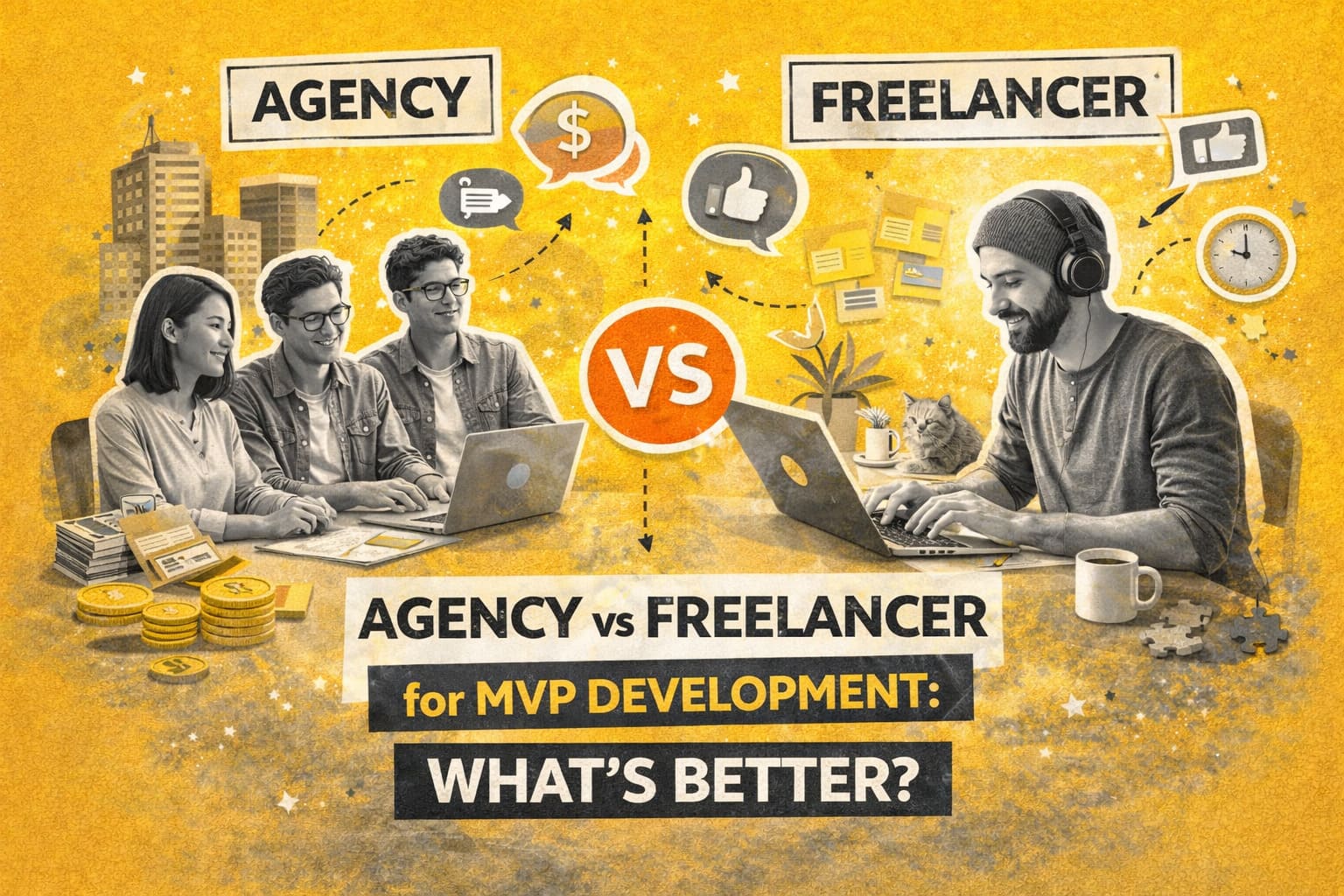
In the high-stakes world of early-stage startups, the journey from a "lightbulb moment" to a functional product is fraught with critical decisions. Perhaps none is more influential on your eventual trajectory than choosing who will build your Minimum Viable Product (MVP). It is the foundation upon which your entire business will rest. As you stand at this crossroads, you are likely weighing two primary paths: hiring a solo freelancer or partnering with a professional development agency. While the lure of lower hourly rates from a freelancer is tempting, the comprehensive nature of MVP development often requires a breadth of expertise that a single individual struggles to provide.
The debate of "Agency vs. Freelancer" isn't just about cost; it’s about risk mitigation, speed-to-market, and the architectural integrity of your vision. For founders, the MVP is more than a prototype; it is a proof of concept designed to secure funding, attract early adopters, and test core hypotheses. In this exhaustive guide, we will break down the nuances of both models, examining reliability, scalability, cost predictability, and long-term growth to help you determine which partner is right for your startup’s unique needs.
The Landscape of MVP Development in 2026
Modern product development has evolved far beyond simple coding. Today, a successful MVP requires a fusion of product discovery, strategic user experience design, robust backend architecture, and a keen understanding of market positioning. The complexity of the modern tech stack means that "full-stack" is often a misnomer; true full-stack capability includes not just frontend and backend code, but also DevOps, security, and data privacy compliance.
When choosing between an agency and a freelancer, you are essentially choosing between a specialized ecosystem and a versatile individual. According to recent industry data, startups that invest heavily in the discovery phase—often a hallmark of agency workflows—are 2.5 times more likely to succeed in their first two years. This is because an MVP isn't just about building features; it's about building the right features for the right audience.
"The goal of an MVP is not to see if a product can be built. The goal is to see if a product should be built and if it solves a problem effectively enough for users to pay for it."
Reliability: Accountability vs. The "Single Point of Failure"
Reliability is the bedrock of any development project. When you are on a tight timeline to pitch to investors or launch at a specific industry event, you cannot afford delays.
The Freelancer Reality
Hiring a freelancer is a bet on an individual. While many freelancers are highly skilled and professional, they are subject to life’s unpredictability. If your freelancer falls ill, experiences a personal emergency, or—as is common in the gig economy—gets offered a high-paying full-time role elsewhere, your project stops dead in its tracks. This is known as the "Single Point of Failure" risk. Furthermore, most freelancers juggle multiple clients. Your priority might be their third or fourth priority on any given Tuesday.
The Agency Advantage
A professional agency provides a structural safety net. When you engage in web app development with an agency, you aren't just hiring a programmer; you are hiring an organization. If a primary developer on your project is unavailable, the agency has the depth of talent to swap in another qualified team member without losing momentum. Agencies operate on contracts that include Service Level Agreements (SLAs) and institutional accountability. At Rethink Lab, we emphasize continuity; our processes ensure that documentation is thorough so that the "tribal knowledge" of your project is owned by the agency, not locked in one person's head.
The Freelancer Disappearance Act
"Ghosting" remains one of the highest risks when working with solo contractors. Without the legal and professional infrastructure of a registered firm, the recourse for a founder when a freelancer stops responding is often limited and expensive to pursue.
Skill Depth and the "T-Shaped" Talent Myth
A common misconception is that a single talented freelancer can handle everything from UX/UI design to database optimization and server deployment. While "T-shaped" individuals (those with deep knowledge in one area and broad knowledge in others) exist, they are rare and expensive.
Freelancers: The Generalist's Struggle
A freelancer who is a world-class React developer might only have a passing knowledge of cybersecurity. A designer who creates beautiful mockups might not understand the intricacies of API integration. This often leads to a "Frankenstein" product—an MVP where some parts are strong, but others are critically weak. These weaknesses often don't appear until you try to scale, at which point "technical debt" becomes a crushing burden.
Agencies: The Specialized Team
An agency model is built on specialized departments. During an MVP development cycle, your project will typically touch:
- Product Strategists: — To refine your roadmap.
- UX Researchers: — To validate user flows.
- UI Designers: — To create a professional brand aesthetic.
- Frontend/Backend Developers: — To build high-performance code.
- QA Engineers: — To find bugs before your customers do.
This collaborative environment ensures that every aspect of your product is handled by an expert in that specific niche. This multidisciplinary approach is particularly vital during the product strategy and roadmapping phase, where cross-functional input can prevent costly pivot-inducing mistakes later on.
| Feature | Freelancer | Agency |
|---|---|---|
| Core Expertise | Usually one deep niche | Multidisciplinary teams |
| Project Management | Often handled by the founder | Dedicated Project Managers |
| Code Quality Assurance | Self-vetted | Peer-reviewed & QA tested |
| Strategy Input | Limited to technical scope | Business and product strategy focused |
| Security/Compliance | Basic/Standard | Rigorous & Standardized |
Cost Predictability: The Hidden Expenses of "Cheap"
On the surface, freelancers appear significantly cheaper. Their hourly rates are lower because they have lower overhead. However, the "sticker price" is rarely the final cost of a product launch.
The True Cost of Freelancing
Working with a freelancer often requires the founder to act as the Project Manager. If you are spending 10–15 hours a week managing a dev, chasing updates, and translating business requirements into technical tasks, what is the cost of your time? Furthermore, if a freelancer builds an MVP that is unscalable or full of bugs, the cost of a "total rewrite" six months later can be three times the original investment.
The Agency's Value Proposition
Agencies typically offer fixed-price packages or structured "time and materials" with clear milestones. Because agencies have refined their processes over hundreds of builds, their estimates are usually more accurate. You are paying for a "managed outcome" rather than just "hours worked." For many startups, IT outsourcing and Team-as-a-Service provides a predictable burn rate that is easier to report to investors.
The "Cheap" Trap
Hiring a cheap freelancer to build your MVP often results in "Technical Debt"—code that is so messy it must be completely scrapped when you move to Version 2.0. Investing in quality early via rapid development best practices saves thousands in the long run.
Scalability and Long-Term Growth
Your MVP is not the finish line; it is the starting block. As your user base grows, your technology must grow with it.
Freelancer Limitations in Scaling
If your product goes viral or lands a major enterprise contract, can your freelancer handle the sudden demand for new features, 24/7 uptime monitoring, and security audits? Most cannot. At this stage, founders often find themselves scrambling to hire an agency anyway, or trying to onboard a full-time team to fix a codebase they didn't write. This transition is notoriously difficult.
Agencies as Scaling Partners
A good agency isn't just a vendor; they function as a technical co-founder. They build with the future in mind, using modern architectures (like microservices or serverless) that can handle growth. Agencies can also assist in the transition phase—helping you hire your in-house team and performing a seamless handoff of the codebase when you are ready to bring development internal.
Risk Mitigation: IP Protection and Legal Security
For a startup, your Intellectual Property (IP) is your most valuable asset. Protecting it is non-negotiable.
- Contracts: — Agencies have standard, legally-vetted contracts that clearly state you own the code, the designs, and the IP from day one.
- Jurisdiction: — If you hire a freelancer in another country and they disappear with your source code, legal recourse is virtually impossible. Agencies provide a level of corporate accountability that protects your investment.
- Documentation: — Freelancers often skip documentation to save time. Agencies emphasize it because they know the value of a maintainable codebase.
"Investors don't just look at the product; they look at the 'build history.' A clean, documented, and professionally managed codebase from an agency is a massive checkbox for Due Diligence."
The Hybrid Approach: When Freelancers Make Sense
We would be remiss if we didn't mention when a freelancer is the right choice. If you are an experienced technical founder who can write the architecture yourself and just need "extra hands" to execute specific, well-defined tasks, a freelancer can be a cost-effective choice. However, if you are a non-technical founder or a business-focused team, the "management overhead" of a freelancer often outweighs the savings.
For those looking for a middle ground, Rethink Lab offers consulting and mentorship, helping founders navigate these choices and ensuring they don't fall into common development traps.
Case Study: The Pivot That Saved the Product
Consider a recent fintech startup that initially hired three separate freelancers to build their mobile app: one for UX/UI design, one for the iOS app, and one for the backend. After four months, the components didn't fit together. The backend was too slow for the UI's requirements, and the designer hadn't accounted for data latency.
They came to us for an UX audit and a technical rescue. By moving to an integrated agency model, we were able to:
- Synchronize the design and development teams.
- Implement workflow automation to speed up testing.
- Rewrite the core API to be 400% faster.
The startup launched six weeks later and successfully raised their Seed round. The cost of the agency was higher than the freelancers, but the cost of the four wasted months with the freelancers was the true "expensive" mistake.
Why the Agency Model is Safer for Startups
The structured agency model is designed to absorb the shocks of the startup world. At Rethink Lab, we utilize AI prototyping and AI automation to shorten development cycles without sacrificing the quality that comes from human-led strategy. This combination allows startups to move as fast as a freelancer but with the stability of a 50-person firm.
Integrated Quality Assurance
In a solo freelancer setup, the person who writes the code is the same person who tests it. This is a recipe for overlooked bugs. Agencies employ dedicated QA specialists whose only job is to try and break the application. This ensures that when your MVP hits the App Store, it's polished and professional.
Strategic Roadmap Alignment
Freelancers are "order takers." If you ask for a feature, they build it. A professional agency acts as a "strategic partner." If you ask for a feature that doesn't align with your goals or might bloat the MVP development unnecessarily, an agency will push back. This "healthy friction" is what separates successful products from those that get lost in the noise.
Making the Decision: A Framework
If you are still unsure, ask yourself these five questions:
- Is my product technically complex? (Does it involve AI, complex data processing, or high security?) -> Choose Agency.
- Do I have 20+ hours a week to manage a developer? -> No? Choose Agency.
- Will I need to raise venture capital within 12 months? -> Yes? Choose Agency (for the clean cap table and IP security).
- Is this a "throwaway" prototype just to show a few friends? -> Yes? Choose Freelancer.
- Am I a technical expert who can review every line of code? -> Yes? Choose Freelancer.
Leveraging Modern Efficiency: The Rethink Lab Way
We understand that for many startups, the high cost of traditional agencies in the past was a barrier. That’s why we’ve revolutionized our approach using rapid development methodologies. By combining seasoned experts with cutting-edge AI automation, we deliver agency-grade quality at a speed and price point that makes the "freelancer vs. agency" debate an easy choice.
Whether you need a complete web redesign to modernize your current presence or a ground-up mobile app development partner, we provide the infrastructure that solo contractors simply cannot match.
Conclusion: Building for the Long Term
The choice between an agency and a freelancer for your MVP development is ultimately a choice between short-term savings and long-term stability. While freelancers can offer a quick, inexpensive fix, the agency model offers a comprehensive, risk-mitigated path toward a successful product launch and beyond.
Your MVP is the first impression your company makes on the world. It should reflect the quality, ambition, and professionalism of your vision. Don't leave that to chance. Partner with a team that has a proven track record of turning ideas into market-leading products.
Ready to take the next step in your product journey? Explore our pricing to see how we can fit into your startup's budget, or get in touch with our team today to discuss your vision. Let’s build something that lasts.