
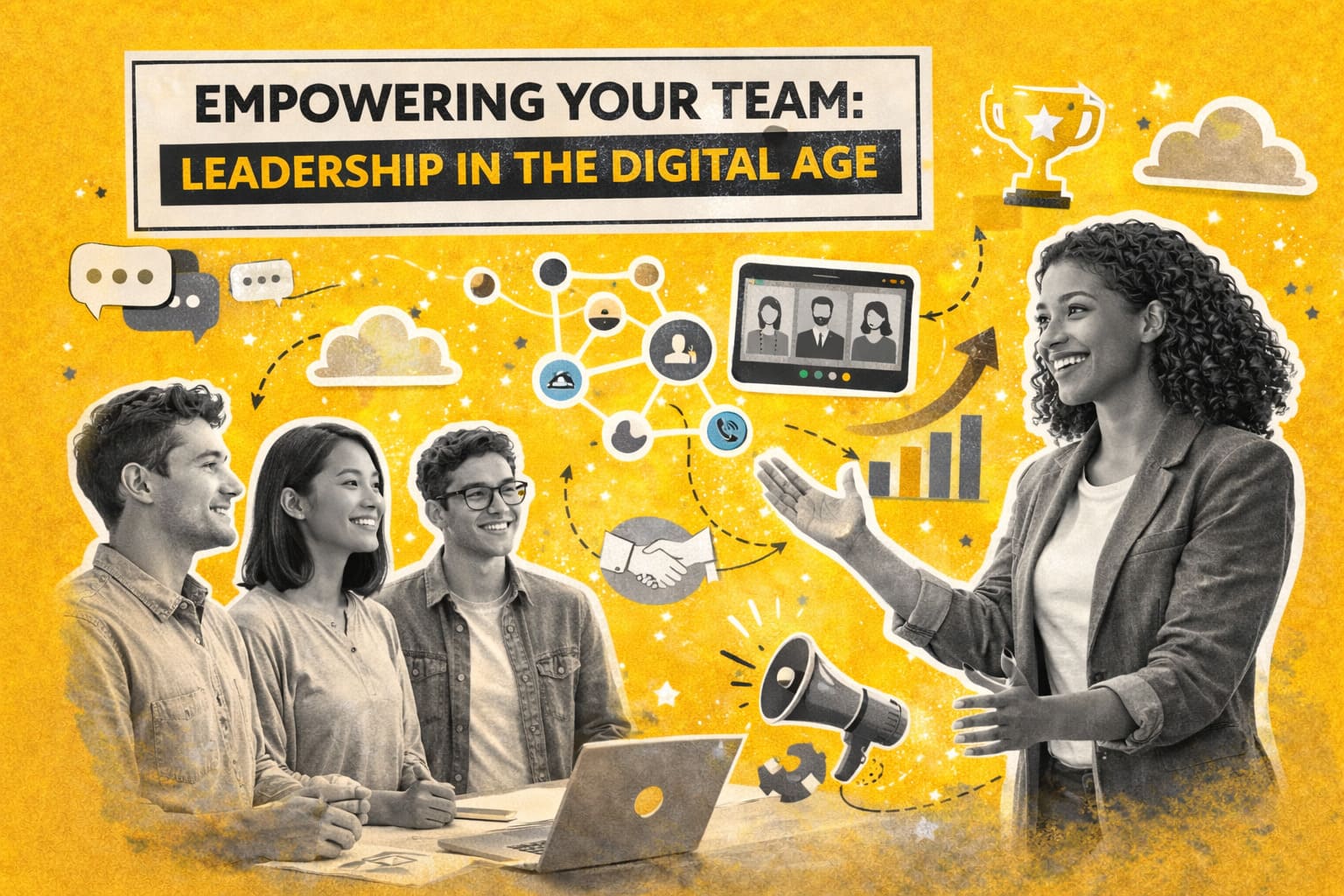
In the rapidly evolving landscape of the 21st century, leadership is no longer about proximity, punch-clocks, or top-down mandates. As digital transformation accelerates, the traditional command-and-control hierarchy—a relic of the industrial age—is being replaced by agile, decentralized, and empathetic frameworks. For companies looking to scale, whether they are early-stage startups or established enterprises, the ability to empower a team is often the deciding factor between stagnation and market dominance. At Rethink Lab, we believe that the foundation of any successful venture—be it MVP development or a large-scale digital overhaul—lies in the strength, autonomy, and psychological safety of its people.
The Evolution of Modern Leadership: From Oversight to Orchestration
The shift from industrial-age management to digital-age leadership is more than a change in software or office layouts; it is a fundamental shift in human psychology and organizational design. In the past, leaders were valued for their niche expertise and their ability to supervise every minute detail of a worker's day. The manager was the "brain," and the employees were the "hands."
Today, in a world dominated by knowledge work, the best leaders are those who act as catalysts rather than bottlenecks. Modern leadership is characterized by the transition from "manager" to "coach." A manager tells people exactly what to do; a leader asks what tools they need to do their best work and then relentlessly removes the obstacles in their path. This is particularly crucial when navigating complex technical projects like web app development, where the technical nuances are so deep and fast-moving that no single person can possess all the answers.
"Management is about persuading people to do things they do not want to do, while leadership is about inspiring people to do things they never thought they could do." — Steve Jobs
The goal of the modern leader is to create an environment where the most talented individuals feel they have the agency to innovate without fear of retribution. This requires a shift from tracking inputs (hours worked) to measuring outcomes (value created).
The Death of Micromanagement
Micromanagement is the silent killer of productivity and the primary driver of employee turnover in the digital sector. It leads to decision fatigue for the leader and total disengagement for the employee. In the digital age, where information flows instantly and tasks can be completed from anywhere in the world, trying to track every mouse click is a fool’s errand that destroys trust.
When a leader micromanages, they effectively cap the team's potential at their own personal bandwidth. If every decision must go through one person, the organization can only move as fast as that person can process emails. By removing the shackles of micromanagement, you signal to your team that you trust their professional judgment, which is the ultimate driver of high performance and long-term retention.
Core Principles of Empowered Leadership
To lead effectively in a digital-first world, there are several non-negotiable principles that must be integrated into your organizational DNA. These aren't just HR buzzwords; they are the structural pillars that support growth, scalability, and technical excellence.
1. Autonomy with Strategic Alignment
The most successful teams are those that understand the "why" behind their work. When you provide autonomy, you are giving your team the freedom to decide how to solve a problem. However, autonomy without alignment is recipe for chaos.
- Define the "North Star" — Every team member should know the company’s long-term vision. If the goal is to become the most user-centric fintech app, every design choice should reflect that.
- Set Key Results — Use frameworks like OKRs (Objectives and Key Results) to provide measurable goals while leaving the tactics up to the individuals.
- Provide Guardrails — Autonomy doesn't mean a lack of structure. It means having clear boundaries (budgets, timelines, ethical standards) within which creativity can flourish.
For example, when we provide consulting and mentorship, we emphasize that leaders should spend 80% of their time clarifying the problem and only 20% helping the team refine the solution.
2. Psychological Safety and the "Fail Fast" Mentality
Innovation is inherently risky. If your team is afraid to make mistakes, they will never suggest the "crazy" idea that could become your next breakthrough product. Psychological safety—a term coined by Harvard professor Amy Edmondson—is the belief that one will not be punished or humiliated for speaking up with ideas, questions, concerns, or mistakes.
| Traditional Culture | Empowered Culture |
|---|---|
| Mistakes are punished | Mistakes are learning opportunities |
| Top-down decision making | Collaborative problem solving |
| Feedback is annual/formal | Feedback is continuous/real-time |
| Information is hoarded | Information is transparent |
In the world of rapid development, speed is of the essence. Speed requires a high tolerance for error, provided those errors are caught early and used as fuel for the next iteration.
Pro Tip
Start your weekly meetings by sharing a mistake you made that week. This "vulnerability signaling" from the top down makes it safe for everyone else to be honest about their own challenges.
3. Continuous Learning and Skill Evolution
The shelf life of technical skills is shorter than ever. A developer skilled in today’s languages may find their knowledge obsolete in three to five years if they don't adapt. As a leader, you must invest in your team’s growth not just for their benefit, but for the company’s survival.
- Stipends for Education — Provide dedicated budgets for courses, certifications, and conferences.
- Internal Knowledge Sharing — Host regular "lunch and learns" where team members teach each other about new trends, such as AI automation or new design systems.
- Stretch Assignments — Give people tasks that are 10-20% outside their current comfort zone to encourage neuroplasticity and professional confidence.
4. Transparent Communication and Context-Sharing
In many traditional organizations, information is hoarded as a form of power. In an empowered team, information is shared as a form of fuel. Giving your team the full context of a business decision—including the financial constraints, competitive landscape, and market pressures—allows them to make better decisions independently.
- Open the Books — To the extent possible, share high-level financial health and strategic pivots. When employees understand the "unit economics" of the business, they are more likely to care about efficiency.
- Explain the "Why" — If a project is cancelled or a budget is cut, explain the reasoning. People are much more resilient when they understand the logic behind the change rather than feeling like victims of a whim.
- Use the Right Tools — Leverage platforms like Slack, Notion, or Jira to ensure that communication is searchable and accessible to everyone, not buried in private, siloed emails.
Navigating the Challenges of a Remote-First Culture
The Digital Age has effectively detached the workplace from the office. For many firms, this means managing a global workforce across multiple time zones. While this offers access to a diverse talent pool, it requires a complete rethink of how leadership functions daily.
Async by Default, Sync when Necessary
One of the biggest mistakes remote leaders make is trying to recreate the 9-to-5 office environment via endless Zoom calls. This leads to "Zoom fatigue" and prevents the "Deep Work" necessary for coding and design.
- Respect Deep Work — Encourage hours of uninterrupted focus time where notifications are turned off.
- Master Written Communication — In a remote world, writing is a core leadership skill. Every major decision should be documented so that someone in a different time zone can understand the "how" and "why" without needing a meeting.
- Synchronous is for Connection — Reserve live meetings for high-bandwidth activities: brainstorming, complex conflict resolution, or social bonding.
Documenting Decisions, Not Just Discussions
In a physical office, you can lean over a desk to ask why a certain design choice was made. In a remote setup, that tribal knowledge is lost if it isn't documented.
- Centralized Knowledge Base — Maintain a "Wiki" or a "Company Handbook" that serves as the single source of truth for everything from HR policies to deployment workflows.
- Decision Logs — Keep a record of major technical and strategic decisions. This is vital when you are scaling mobile app development and new engineers join the team mid-stream.
- AI-Enhanced Documentation — Use tools to record and summarize meetings automatically, ensuring that the "essence" of a discussion is searchable for future reference.
Fostering Human Connection in a Digital Space
Isolation is a real risk for remote teams. Leadership in the digital age requires intentionality in building a culture of belonging that transcends the screen.
- Virtual Watercoolers — Use Slack channels for non-work topics like hobbies, pets, or gaming. This builds the "social capital" necessary to survive stressful project phases.
- Meaningful One-on-Ones — These should NOT be status updates (those can be written). They should be focused on the individual’s mental health, career goals, and identifying organizational roadblocks.
- The "High-Fives" Culture — Create a system for peer-to-peer recognition. When a developer helps a designer understand a technical constraint, that should be celebrated publicly.
Building and Scaling High-Performance Teams
Hiring is the most important "product" a leader ever builds. If you hire the right people and put them in a great environment, they will largely manage themselves. But identifying who will thrive in a high-autonomy culture requires a different interview lens.
Hiring for Values and Potential over Legacy Skills
Technical skills can be taught, but curiosity and cultural alignment cannot. When we look for a technical co-founder or a lead engineer for a client, we prioritize three traits:
- Adaptability — Have they shown the ability to learn new frameworks quickly when the market shifts?
- Owner Mindset — Do they take responsibility for the final user outcome, or do they just "check boxes" on a Jira ticket?
- Communication Skills — Can they explain complex technical concepts to non-technical stakeholders without being condescending?
The Role of Technology in Team Empowerment
You cannot expect a high-performance team to work with low-performance tools. Leadership involves ensuring your team has the best "tech stack" to support their workflows and minimize friction.
- Leveraging AI — Empower your team by implementing AI prototyping tools that allow them to move from idea to wireframe in hours rather than weeks.
- Automation — Use workflow automation to remove the "grunt work" from their daily routine (like manual testing or data entry), allowing them to focus on high-value creative tasks.
- Design Systems — Investing in a robust UX/UI design system ensures that your developers and designers can collaborate using a shared language, reducing the need for constant back-and-forth "fixes."
Transforming Strategy into Execution
A leader’s job is to bridge the gap between a high-level vision and tactical execution. This is where product discovery becomes an essential leadership tool. By involving the team early in the discovery phase, you are not just getting their input; you are securing their emotional buy-in.
Collaborative Roadmapping vs. Dictated Timelines
Traditionally, a CEO would hand a roadmap to the team and say "build this by Q3." In a modern framework, the leader presents the business goals and the team helped build the roadmap to reach those goals.
- Early Involvement — Developers and designers should be involved in initial stakeholder interviews. Hearing a customer's pain point firsthand is a much stronger motivator than reading a summary of that pain.
- Transparency in Trade-offs — When resources are limited, the team should understand why certain features are prioritized. This prevents resentment when a "cool" feature is cut for a "necessary" one.
- The "Whole Product" Concept — Encourage everyone to think about the user journey, not just their specific lane. A back-end developer who understands UX audit results will write better, more performant code that supports the user's flow.
The Power of Team-as-a-Service
Sometimes, empowering your internal team means bringing in outside expertise to fill critical gaps so the core team doesn't burn out. This is the essence of IT outsourcing and team-as-a-service.
- Burst Capacity — Bringing in external specialists for a web redesign allows your core team to stay focused on long-term product-market fit.
- Skill Transfer — A good external partner doesn't just deliver a file and leave; they leave your internal team better than they found them by introducing new testing standards or agile methodologies.
Leadership in Times of Change and Crisis
The digital age is characterized by high volatility. Markets shift overnight, new technologies (like Generative AI) disrupt established business models, and global events can change how we work in an instant. Leadership during these times requires a balanced approach of radical honesty and optimistic vision.
Communicating During a Pivot
When a company needs to change direction, the leader’s role remains to provide a sense of stability amidst the storm.
- Be Honest About the "Why" — If a product-market fit isn't there, or a competitor has leapfrogged your tech, admit it. People respect honesty more than false confidence.
- Highlight the Opportunity — Every pivot is an opportunity to shed technical debt and start fresh. Frame the change as a strategic evolution rather than a failure.
- Involve the Team in the Solution — Ask the team for their ideas on how to navigate the transition. You’ll be surprised at the innovative solutions that surface when people feel their survival is tied to their creativity.
Managing Burnout in a Hyper-Connected World
The "always-on" nature of digital work is a double-edged sword. While it allows for flexibility, it also makes it difficult for employees to truly disconnect and recharge.
Warning: The Burnout Trap
High-performers are often the first to burn out because they have a high sense of responsibility and don't know how to say "no." It is the leader's job to protect them from their own drive.
- Set the Example — If you send Slack messages at 2:00 AM, your team will feel they need to respond at 2:00 AM. Use "Schedule Send" or wait until the morning to respect their boundaries.
- Encourage "Off" Time — Make sure employees are actually taking their vacations—and that means no checking messages. Lead by example by taking your own "unplugged" time.
- Monitor Workloads — Regularly check in to see if any one person is carrying too much of the load. Look for signs of fatigue: increased irritability, decreased quality of work, or withdrawal from social interactions.
Cultivating a Culture of Excellence
Ultimately, leadership is about culture. Culture isn't what’s written on the "About Us" page; it’s what happens when the CEO isn't in the room. In the digital age, culture is the operating system (OS) of your company.
The Feedback Loop: Rapid and Multi-Directional
A culture of excellence is built on continuous feedback. But traditional annual reviews are too slow for the digital age. By the time the review happens, the project is long over and the lessons are forgotten.
- Real-Time Feedback — Give praise and constructive criticism in the moment. "I loved how you handled that client objection" or "That code could be more readable" is 10x more effective when said immediately.
- 360-Degree Reviews — Allow team members to give anonymous feedback to their leaders. This promotes radical accountability and shows that no one is "above" the culture.
- Actionable Insights — Feedback should always be tied to specific behaviors and outcomes, never personality traits. Focus on "The results showed X" rather than "You are Y."
Creating a Shared Identity and "Small Wins"
Even in a distributed team, there needs to be a sense of "us." Without it, employees feel like mercenaries just trading hours for dollars.
- Shared Rituals — Whether it’s a weekly "wins" call, a virtual trivia night, or a casual "Friday Demo," rituals build the connective tissue of a team.
- Celebrating the "Unseen" Work — In long-term projects like web design, it can be months before the final product launches. Celebrate the milestones: the first successful API call, the completion of the design system, or a successful user test.
- Living the Values — If one of your values is "User First," then every decision—no matter how small—should be held up against that standard. If a feature would increase revenue but hurt the user experience, a "User First" culture rejects it.
The Path Forward: Leading Toward the Future
Leadership in the digital age is an ongoing journey of unlearning old habits and embracing new ones. It requires a high level of emotional intelligence, a willingness to be vulnerable, and a deep-seated belief in the potential of your team.
By focusing on autonomy, psychological safety, continuous learning, and transparent communication, you create an environment where high-performance isn't just a goal—it’s an inevitable outcome. Whether you are building an AI-driven prototype or redesigning a complex enterprise system, the quality of your leadership will define the quality of your results.
Summary Checklist for Digital Leaders:
- Do my employees feel safe enough to tell me when an idea is bad?
- Have I provided the "Why" behind our current sprint?
- Am I measuring people by their output or their "desk time"?
- Does the team have the workflow automation they need to stop doing busy work?
- When was the last time I invested in someone's professional development?
At Rethink Lab, we don't just build products; we help leaders navigate these cultural and technical shifts. We understand that the most beautiful UX/UI design or the most efficient product strategy is only as good as the team empowered to execute it.
If you’re ready to empower your team and take your digital strategy to the next level, we are here to support you. From providing a technical co-founder to augmenting your existing staff through our IT outsourcing model, we provide the expertise and partnership needed to thrive in the modern era.
Let's build something extraordinary together. Contact us today to learn more about how our services can help you scale your vision and lead your team to enduring success.